

What if everything you believed about yourself was totally wrong?
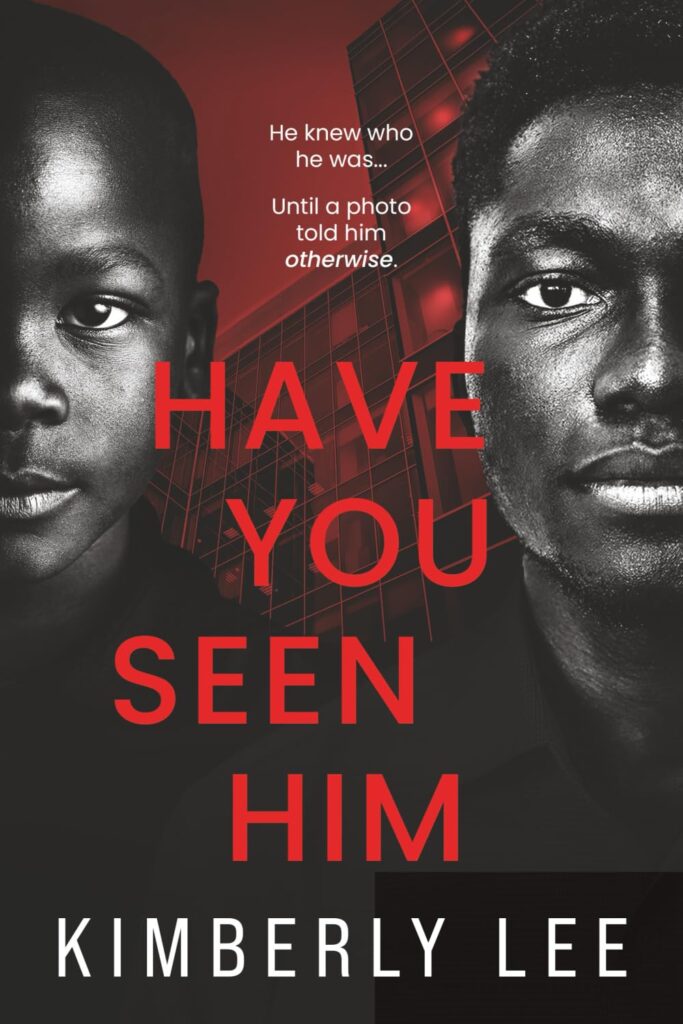
This is an exclusive excerpt of Have You Seen Him, a novel by Kimberly Lee.
Before
Any dead bank employee could tell you this simple fact—bulletproof glass only works if you’re standing behind it. So if you were like Olivia, just promoted to loan officer with a lovely desk out on the floor, you were well on your way to essentially becoming a sitting duck.
Olivia’s aunt brushed off her reservations as they sat in the orderly kitchen that night. Aunt Bernice was a no-nonsense woman; the shiny fixtures and appliances gleamed. “That’s got to be one of the best opportunities you’re gonna get without a college degree. Don’t you dare tell me you’re thinking about turning it down. You better accept that position like the smart girl I raised you to be.”
“I know, Aunt Bernice,” Olivia said, moving to the sink to rinse her teacup. “And you’re right. I already accepted the spot.” She wiped the sink with a yellow kitchen towel and folded it into a tight square, then placed it onto the counter.
“Well, good. You worked hard enough to get it.” The dilemma resolved, Olivia’s aunt returned her rhinestoned cat-eye glasses to her face, her attention back to her ledger.
Despite the increased paycheck and enviable benefits, Olivia’s initial anxiety about her new position never waned. She’d watched too many movies and was highly suggestible, easily spooked by the images she’d seen. She was drawn to crime thrillers, often centering banks, a morbid pull she knew wasn’t good for her. And the little measures she developed to soothe her fears—entering and exiting the establishment only in the company of other workers, fingering the panic button under her desk—didn’t have much of an effect. She tried to be as thrilled as Aunt Bernice was about the new position, but she would have done better to follow the older woman’s more relevant, oft-repeated advice: “Always follow your gut.”
Olivia’s final transaction was a simple one—to close the accounts of a nice-looking family who was moving out of state. They’d arrived at her desk with pointed looks, their identification documents at the ready, their slips filled out. She worked more efficiently than usual, wondering about their backstory. $75,000 was a lot to take in cash.
Olivia snuck long glances at the family as she handled their transaction. The mother had a soft, understated beauty. Something about her was fragile, almost sickly. The teen daughter was pretty, yet solemn. But it was the father’s face, the last one Olivia was to see in this life, that would have haunted her, had she lived.
The robbers approached her desk with small guns in their outstretched arms. Some patrons gasped and others screamed, clutching the nearest stranger. The mother and daughter froze, but the father simply looked at Olivia with bemused resignation, a knowing that this was the end. As if he’d been expecting it.
The handsome man had taken a visible and audible deep breath, slowly closing his eyes then opening them as a handgun was pushed into his neck. Olivia’s ears registered the shots as if they’d taken place far away, on another planet, and she felt the muscles in her own neck clench while blood spurted out of the man. Frozen, she watched the client’s body lean towards her and slump over, his eyes locked on a small, worn photo in his hand. The picture slipped onto Olivia’s desk and she studied the boy’s face, his gleaming eyes. But then the gun turned to Olivia, commanding her attention. The barrel’s diameter was smaller than the ones she’d seen on TV. But just as effective.
Part I
25 Years Later
One
David placed his stack of files on counsel table, then glanced around the small courtroom. He surveyed the sullen faces of the other workers, their mouths in straight lines, their dull eyes. The prevailing sentiment was obvious—none of them really wanted to be there. Not the bailiff, the court reporter, the probation officer, and certainly not the minors seated with their parents just outside the tiny room. Even Commissioner Wong was checking her watch, as if she had more pressing things to do. David shook his head slightly. Sometimes he felt this whole thing was a huge waste of time and money, a misuse of precious resources. Truth and justice were rarely excavated here; it was all performative. The general public, duped by its addiction to ever-present legal fare on TV, was under the mistaken impression that courtrooms were dramatic, exciting places. Those employed in the field knew that on most days, a job at the dry cleaners—sending racks of clothes around an never-ending steel track—would be more thrilling.
David was once again covering for a sick office mate. This time it was Department 51 for Todd, out with the flu. Calling in sick and taking the day off was a luxury reserved for either the truly afflicted or the dishonest. David was neither. His secretary had practically salivated when she saw how much sick time he’d accrued—and how much he’d get if he cashed it out.
The case he was subbing in for was uncomplicated. Todd had gone over it with him on the phone—a quick win on a technical issue. The minor had shoplifted a bottle of Jack Daniels from the Ralph’s in Ladera Heights. Fortunately for the kid, the city fathers of Los Angeles and Inglewood had drawn the boundaries such that half of the store was in Los Angeles proper; the other half was in Inglewood. The wine and spirits aisle was on the LA side, as was the door the kid had dashed out of. The case had been filed in Inglewood, so David would argue improper venue. The Inglewood court had no jurisdiction to hear a case about an alleged crime that had taken place in LA, so it was a sure dismissal. The prosecutor would promptly transfer and refile the matter in the proper court. But it would be a win for the public defenders’ books, regardless. And the kid, clearly in need of some supervision, would eventually get just that.
The other items on David’s calendar for the morning were nondescript, requiring little effort on his part. Kids on probation had to appear before the commissioner at regular intervals to show they’d performed community service, attended anti-bullying workshops, or otherwise followed through on some order given in lieu of more severe punishment. These matters were simple—either the kids had completed the prescribed tasks or not. If proof was shown, they’d get to go home; if not, off they’d go, into custody and on their way to boot camp in the mountains.
The courtroom’s side door opened and David glanced over. A scrawny kid entered with the bailiff and took a seat. The boy sat at counsel table in a gray jumpsuit, looking around the courtroom with jerky, anxious movements. No lawyer joined him, making David wonder if the court would assign the matter to his office. He caught the eye of the probation officer, who just shrugged. Though he knew nothing about the child, David felt sympathy for the boy, a strange kinship.
He opened one of his files and started reading a police report. The boy at the table popped up and his chair fell backwards to the ground. The bailiff leaped over his desk and went at the boy, who was brandishing a small weapon. A full-fledged struggle started; the kid was stronger than he looked.
“Call the other bailiffs!” Commissioner Wong yelled, then retreated to her chambers.
The probation officer and court reporter both cocked their heads, then looked at each
other for a beat. She’s just going to leave us here? Both stood and hightailed it to the far side of the courtroom. David backed away from the altercation as well, his eyes bouncing from side to side. The women looked at him expectantly. David knew what the look meant. As the only other man in the room, he was supposed to do something. But he’d never been a fighter; he wasn’t the type to jump into the middle of a brawl. What could he do? He turned, grabbed the nearest chair, and threw it in the direction of the ruckus, which had become a living, breathing, two-person creature, with twists and turns and rotations as each party alternately got the upper hand then lost it. The chair landed squarely on the bailiff’s back. Two other deputy sheriffs rushed into the courtroom as the bailiff faltered under David’s “contribution.” They took the boy down swiftly, smashing his face into the courtroom’s dingy carpet. One of the deputies wrestled the weapon from the boy’s grip—a toothbrush that had been whittled and burned into a shank. The bailiff stumbled to his feet as the boy was dragged from the courtroom. He started to follow the motley group through the side door, but glanced back at David, his eyes narrowed, before continuing on.
David’s gaze dropped to the floor and he started to back back out of the courtroom. The court reporter and probation officer stared at him, their eyes wide, scathing. David turned and scurried away, both his files and his ego abandoned at counsel table.
Home, much earlier than usual. The courtroom had gone into recess for the rest of the day while the Sheriff’s Department regrouped, figured out what had gone wrong. David looked around his apartment for a chore, a task, something to keep himself from thinking about facing his coworkers the next day. It was a tall order; he was a minimalist, freakishly neat. Everything was “in its place.” Sifting through junk mail was the thing he resented the most, so David forced himself to do it as penance for his milquetoast behavior in court.
Even though he knew recycling was the right thing to do—for the melting polar ice caps, the coral reef, all that—he hated the monotony of sorting through everything. He suppressed the urge to chuck it all into the same bin. Trash, like pretty much everything else these days, was unnecessarily complicated. Who knew for sure if the carefully categorized items ever even made it to the place where things could be salvaged and revived and turned into handbags made of candy wrappers, seatbelts, and pull-tabs. A documentary he’d watched had uncovered the fact that in at least one town, and probably many others, every single throwaway went to the landfill, whether the bin was blue, black, or green.
But he felt guilty when he didn’t do it, and he had enough things to feel guilty about. The incident at work, his useless behavior. Not picking Gayle up from the airport. He’d wanted to see her, especially after the upsetting day. On the brief phone call before her flight took off, he’d promised to meet her at LAX. But he knew he’d conjure up a reason not to be there. Airports were overripe with too much—too many people, too much movement, too many unknowns.
He rifled through the papers and envelopes. Deals on mattresses, Lay-Z-Boy recliners, chimney cleaning, and towards the bottom of one of the leaflets, the words “¿Me Has Visto?” He had taken Spanish from the voluptuous Mrs. Boyette in 10th grade, so the translation was easy. “Have You Seen Me?”
The pictures accompanying the plea were obscured by something from the Red Cross. He crushed all of the pages into a pointy, misshapen ball, then felt shame for not even glancing at the photo of the poor lost child. He opened the bundle back up and laid the paper on the table, smoothing the crinkled paper with his hands.
David focused in on the ad and saw his own face gazing back at him. He shook his head as if to shake the foolishness out.
“What the—?” His eyes locked on the image. “This. Can’t be real.” He leaned
further in and squinted. The technology had somehow managed to match his exact shade of brown. Although the nose in the picture was a bit too narrow, it was close enough. David had a full, close-cropped beard; the man in the picture barely had a mustache. Regardless, it was him, in a “computer-generated image of subject at thirty-six years old,” as stated by the printed words below the man’s, well, his, picture.
What the hell?
The photo on the left was a picture he’d never actually seen, but it was how he remembered himself at eleven years old, refusing to smile for the goofy school photographer. “Wuss happnen,” the photographer had said as David approached the stool, centered in front of a faded blue background. David frowned. The only people who spoke like that were characters on the old reruns his parents watched. But the photographer had kind eyes. After the photo, David smiled and held out his hand as he exited the bandroom-turned-photo studio. “Gimme five,” he offered, the way he’d seen it done on TV. It made the man’s day; he’d slapped David’s hand with enthusiasm. David was glad he had done it, this grand gesture. The photographer was married to Mrs. Dalton, the hard-faced 3rd grade teacher. He deserved a break.
But David was at a new school, living with his new family, by the time the batch of photos were developed and sent home in cellophane envelopes with his classmates. He’d never seen the pictures.
Until now. He looked at the childhood photo more closely and noticed something. The name printed under his pictures, his images, was not his own. It was “Leonard.” Where had that come from? What was that about? His felt his stomach turn, a symbolic protest. It was too much to digest.
Forgetting he’d failed to pick Gayle up from the airport, David grabbed the phone and tapped her name. He remembered this neglect when she didn’t pick up, and blamed the geniuses in Silicon Valley for alerting her it was him. He hung up and tried again, hoping the second call would convey some urgency. It did, and she picked up but didn’t speak.
“I’m—missing.” He choked out the words.
Gayle was calm. He could hear her inhale deeply and then slowly exhale. “I know. I don’t even want to hear whatever lame excuse you have right now, I had a car bring me home, I’m gonna take a shower and go to bed, I’ll talk to you tomorrow.” Her words were a continuous string of thoughts, as if David wasn’t worth the effort it took to make separate sentences.
“No, I mean, I’m a missing person. I—” David looked around the room, eyes wary, as if someone else was present who might hear this and cart him away.
“Wow.” She paused for a beat. “Creative.” Another beat. “So that’s how you’ve
decided to play this? What is that, a metaphor?” Great, David thought. Gayle resorted to sarcasm when she was agitated. He’d started the conversation knowing he’d be on an uphill battle; he now realized that thought was an understatement. He was climbing Mount Everest.
“Gayle, please, if you would just listen, somebody’s looking for me. I’m on a missing child ad. They have a picture of me when I was eleven, you know, when my parents and my sister left. Somebody’s been looking for me. They have my picture here, what I look like now, but it’s not my name.” It was all coming off like gibberish, but David didn’t care. He had to get it out in one big heap.
“What, are you on a milk carton or something? Like they used to do when we were kids? I thought—? Well, who would be—?”
“Look, can you meet me at Lola’s? I have to show you this. You have to see it.
Apple crisp with a scoop of vanilla—your favorite. My treat.” Talk of dessert seemed surreal under these circumstances.
“Well, what did Hersh have to say about it? You called him?” It was a logical question, and also Gayle’s way of delaying an agreement to meet. She was still pissed off about the airport.
“Yeah, well, I mean no, I’ll talk to him later. I just, I need—you. Please. Please.”
She agreed to meet him. Some things became truth only after he talked to Gayle. Until then, they were just distant clouds that could easily change shape.
Read more of Have You Seen Him — order here on Amazon.
This is an excerpt of Have You Seen Him, copyright 2025 Kimberly Lee. All Rights Reserved. Published by Butterfly Effect Press, Los Angeles.
Learn more about Kimberly Lee here in this interview.