


Exclusive excerpt: ‘Man vs. Menopause: A Husband’s Field Guide’
Most men were never taught enough about women’s bodies. We picked up fragments about puberty and reproduction, then somehow became husbands, partners, fathers, friends, coworkers, and leaders without learning much about periods, pain, perimenopause, menopause, pelvic health, sleep disruption, desire shifts, or the ways women are expected to keep a whole life moving while their bodies change the rules.
That missing education follows us home. It shows up when a husband treats a hot flash like a thermostat dispute, hears exhaustion as rejection, answers brain fog with impatience, or turns a hard conversation about sex into a referendum on whether he is still wanted. He notices the symptom that touches him first and mistakes it for the whole story.
I wrote this book because men are teachable. Most of us are not trying to be cruel. We love our wives and partners, and we want to be decent men. We also have a remarkable ability to walk into a vulnerable moment with one underqualified theory, one badly timed joke, and a facial expression that adds forty minutes to the argument.
The answer is not shame. It is better language, more useful information, steadier attention, and the humility to ask what kind of support would help before charging in with a solution. Men need a guide that tells the truth without making women do all the teaching. Couples need a bridge back into conversations that have become loaded, lonely, or too easy to avoid.
Kellie is at the heart of this book. Marriage keeps asking us to learn the person in front of us now, not only the person we first fell in love with. Midlife makes that lesson impossible to ignore. Bodies, sleep, roles, health, sex, work, family demands, and ordinary patience all change. Love has to keep learning too.
This book uses humor because midlife is weird and pretending otherwise helps no one. The joke, however, is never that women are irrational, dramatic, broken, difficult, or too much. The target is the undertrained husband entering a major body transition with the preparation level of a raccoon operating a forklift.
The practical work is simple to name and harder to live: believe her before the symptoms become undeniable, carry more without waiting for instructions, support qualified care without becoming the medical director of the living room, talk about sex without pressure, repair faster, take care of your own health, and stay close without hovering or making her manage your feelings.
Man vs. Menopause exists to help a husband become less hazardous and more helpful. Not perfect. More attentive. More mature. Easier to trust. The kind of man who notices, learns, adjusts, laughs without cruelty, and makes the life around the woman he loves a little lighter.
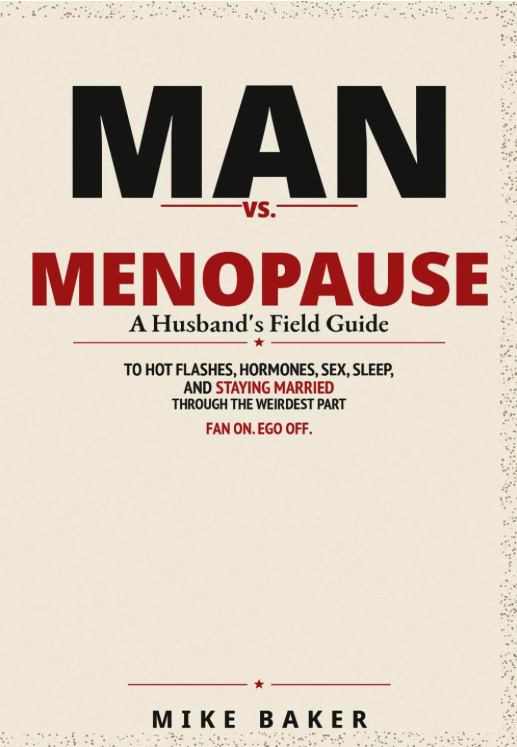
Enjoy this excerpt of Man vs Menopause: A Husband’s Field Guide to Hot Flashes, Hormones, Sex, Sleep, and Staying Married Through the Weirdest Part (Human First) by Mike Baker
Chapter 16: Stop Calling It Helping When You Live There Too
There is a sentence men say that sounds innocent. Helpful, even. It usually comes with good intentions, soft eyes, and the quiet confidence of a man who believes he has made himself emotionally available: “Tell me what you need me to do.”
On the surface, that sounds reasonable. You are offering. You are available. You are standing there, ready to be assigned a task like a golden retriever with thumbs. The problem is that if she has to tell you what needs to be done, she is still managing the work. She is still noticing, planning, prioritizing, explaining, remembering, and tracking the entire household in her head while also dealing with hot flashes, sleep loss, brain fog, anxiety, body changes, work stress, family needs, and whatever fresh nonsense the group chat produced before breakfast.
You think you offered support. She heard a request to become your supervisor.
That is where many men miss the point. If it is your house, your family, your marriage, your dog, your laundry, your dinner, your dishes, your children, your calendar, your trash, your bathroom, and your life, then doing the work is participation in the life you share. Calling it “helping” makes it sound like the whole thing belongs to her and you occasionally wander in as a generous volunteer.
This chapter matters because household labor affects women’s health faster than men realize. When a woman is already sleeping badly, bleeding unpredictably, forgetting words, managing anxiety, moving through body changes, and trying to stay steady inside a body that feels unfamiliar, the home cannot keep treating her as the central operating system. The work of the house is not separate from what she is carrying. It sits right on top of it.
A husband who reduces that load does something deeper than completing chores. He changes the emotional temperature of the home. He makes her life less crowded. He gives her nervous system one less thing to track. He becomes easier to live with, and during this stage, becoming easier to live with is not a small act of love.
The Sigh Is Data
Your wife is exhausted. She may be perimenopause tired, broken-sleep tired, brain-fog tired, hormone-fluctuation tired, work tired, family tired, body-feels-weird tired, or some combination that coffee cannot fully reach.
The kitchen is a mess. There is laundry in the washer. Someone needs a ride. Dinner is not planned. The dog is acting like he has never been fed in his life, despite having eaten four hours ago. You look around, sense danger, and ask what she needs help with. You meant well, but now she has to stop, assess the entire house, decide what matters most, explain the task, possibly answer follow-up questions, and then either trust you to do it correctly or quietly prepare to redo part of it later.
This is why she sighs.
You may think the sigh means she does not appreciate you. The sigh often means the task multiplied. What you thought was an offer became another management request. You added a decision to a brain that may already be out of space.
A better move sounds like ownership. Tell her you are handling dinner and the dishes. Tell her you have the dog, trash, and laundry. Tell her you are taking the kids out for an hour so she has quiet. Better yet, sometimes you do not need to announce anything. You can look around and do something useful because the evidence is sitting right in front of you.
The point is not that you should never ask questions. Questions have a place. The point is that questions cost energy when they require her to keep serving as the household dispatcher. If you ask her to direct every useful thing you do, she remains the manager. You become labor that still requires supervision. That may help a little in the moment, but it does not change the system.
And the system is the problem.

The Magic Fairy Is Not Real
Kellie and I joke about the magic fairy that somehow cleans things up around the house. You know the fairy. The one who moves the stuff off the stairs. The one who throws away the empty box. The one who notices the trash is full. The one who remembers that the thing sitting by the door needs to go to the car. The one who keeps the house from slowly becoming a storage unit with snacks. The joke is funny because it is true enough to sting.
I have had to make a real mental shift here. There are times when I simply do not see the thing that needs to be done. I can walk past something sitting on the stairs that clearly needs to go upstairs, and somehow my brain does not register it as an action item. I can see the trash getting full and still not have “take out the trash” become the first thought in my head. That is honest, and it is still not an excuse.
I have ADHD, so tracking tasks, noticing details, and catching the invisible follow-through does not always happen automatically. But the impact still lands somewhere. If I do not notice the thing, someone else still has to notice it. A household does not pause because my brain failed to label the task. The trash still fills. The item still sits on the stairs. The laundry still waits. The mental note still gets carried by somebody.
That is the part men need to sit with. A reason may explain why something happens, but it does not erase the work someone else had to absorb. ADHD may explain why noticing is harder for me. It does not mean Kellie should become the permanent reminder system for our life.
I have been working harder to notice. I am trying to stop walking past the thing on the stairs. I am trying to take out the trash before Kellie has to remind me. I am trying to see the simple stuff and act on it before it becomes another item she has to assign. Kellie has never been expected to do everything. We both contribute. We both care about the house and the life we have built. This is not a confession that one person does everything and the other person lives like a raccoon with Wi-Fi. But I still need to do better. I think most guys do.
This is where men get defensive. We hear that we need to notice more, and immediately start building a mental exhibit of everything we already do. I get that instinct. Nobody wants to feel erased. But the point is not pretending men do nothing. The point is seeing the gap between showing up when asked and owning what needs to be done. That gap matters. Closing it changes the feel of a house.
Many men believe their wives want more help. Sometimes they do. More often, they want shared ownership. Help waits to be asked. Ownership notices. Help needs instructions. Ownership learns the system. Help expects recognition for effort. Ownership follows through because the work belongs to both people.
Ownership Beats Assistance
A lot of men operate like substitute teachers in their own homes. They mean well, but they do not know the routines, passwords, preferences, supplies, schedules, or where anyone keeps anything. Then they wonder why their wives seem irritated when they “help.”
Imagine a coworker showing up to your job every day for fifteen years and still asking where the printer is. That is how some men sound asking where the lunch boxes are.
She may not be upset that you are participating. She may be exhausted that you still need onboarding.
Ownership changes that. Ownership means learning the life you live inside. It means knowing where supplies are, what routines exist, what needs to happen next, what standards matter, what deadlines are coming, and what “done” actually means. It means you stop acting like the home is a place where you occasionally volunteer.
A house is not her department. A family is not her project. The calendar is not her personal hobby. Dinner is not her recurring event. Laundry is not women’s folklore. This is shared life, and shared life requires shared ownership.
What do you think of this book excerpt? Let’s talk about it here on The Midst Substack.