

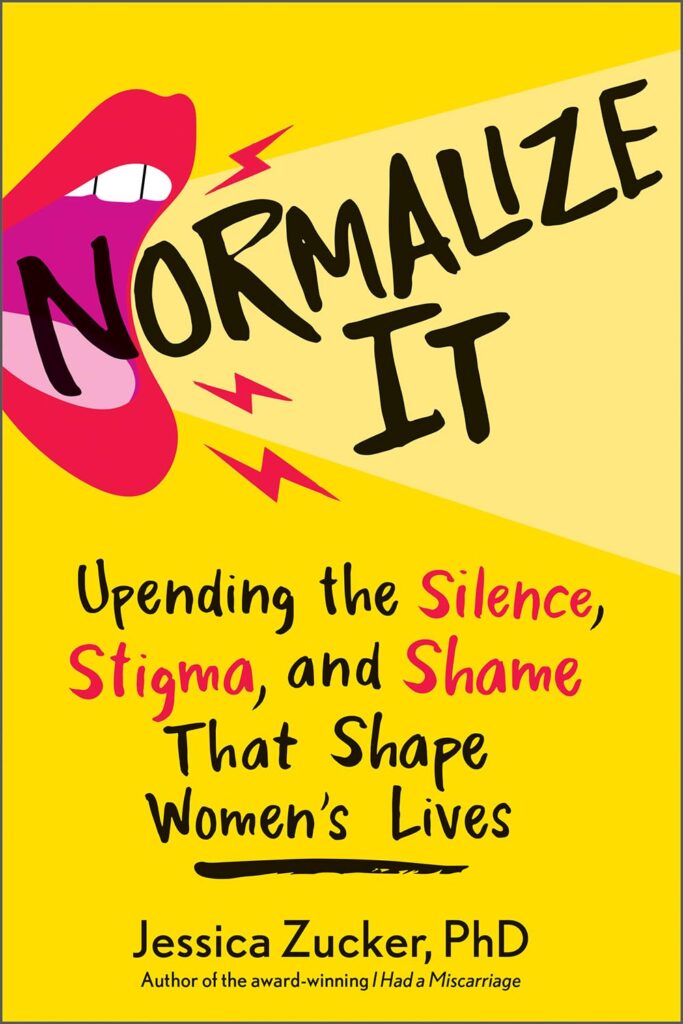
Exclusive excerpt: “Normalize It” by Jessica Zucker PhD, leader of #Ihadamiscarriage movement
This is Chapter 12, “On Change,” of Normalize It: Upending the Silence, Stigma, and Shame That Shape Women’s Lives by Jessica Zucker PhD
Nova, whom I’ve been seeing for half a decade, relaxed into my couch while shaking out her golden wavy locks during our morning session. A fashion photographer known for her gritty celebrity cover shoots and glossy yet edgy editorials, Nova was a woman who has not only survived but succeeded in a male-dominated profession through its most misogynistic decades. Her self-assurance showed in the way she carried herself—she was no stranger to challenging stereotypes with an unflinching gaze.
Now in her mid-fifties, Nova originally came to me to talk about her childhood and how it had shaped so much of her path, her tenacity, and her “rebellious” streak. But recently, our conversations had turned to her most recent challenge: menopause.
“It’s equal parts relieving and . . . I don’t know . . . insulting, I suppose,” Nova said with a laugh during a recent session. “It is utterly wild that society thinks women in menopause should just fade into oblivion when that is so far from the truth of our lives.”
Nova was a few years into menopause at this point and was slowly acclimating to (or, at least, begrudgingly accepting) some of the common symptoms many women deal with during this phase: hot flashes, night sweats, a slower metabolism, vaginal dryness. She’d been surprised when she started experiencing symptoms in her mid-forties, and for years, it didn’t occur to her that this could be the start of menopause. “My doctor just kept telling me I was ‘stressed’ and didn’t mention perimenopause to me at all,” she said. Now, her symptoms were fairly well managed. “I switched providers about a year ago—I finally got fed up with the dismissiveness of my longtime doctor who didn’t take my symptoms seriously,” she said, twisting one of the many silver rings latticed over her fingers.
“It’s not the physical changes that bother me so much,” she continued. “Sure, I miss my formerly perky breasts and my seemingly inexhaustible sex drive. I don’t love being a bit thicker around the middle. Or the brain fog. And fuck mood swings. But . . .” She opened her hands. “Life is change! I’ve always embraced that. And I honestly feel a secret thrill about the way my body is changing—it’s seen a lot and it’s pretty miraculous how it just keeps going, constantly evolving.” Nova examined the edge of her midi-length slip dress. “It’s the way that the rest of the world suddenly starts treating you differently that’s so interesting. To feel invisible after all these years of being objectified—my body, the way I moved in it, the attention I got—is both frustrating and also somewhat liberating.”
I was frankly inspired by Nova’s awe at the way her body was subtly changing with age. Getting to that place is a long road for many women, and it was refreshing to see Nova feel so at home with herself during this phase of her life. But even with her positive attitude, the changes in how society saw her had been disorienting. Recently she’d lost out on a job with a brand she’d worked with successfully for years; they had instead hired someone with a fraction of her experience, and she was sure it had something to do with her age.
“I have spent the past three decades photographing rock stars and A-list celebrities and my work is pretty universally known as relevant. Respected. But suddenly I have a 28-year-old photo editor telling me they’re going with someone whom they think ‘understands the point of view’ of their demographic better,” she said. “Normally I wouldn’t harp on this—it’s not like I haven’t lost out on plenty of jobs in my career. But the thing that drives me absolutely mad is that they didn’t even ask me to pitch a concept. I actually had a lot of ideas about a new aesthetic feel for this particular brand, but they didn’t even consider me. They just wrote me off as irrelevant.
“I am so sick of everyone talking about this phase of life as an end for women,” Nova said, her hazel eyes narrowing. “When it’s so clear that it’s a goddamn beginning.”
If cultural messages tell women that fertility is where womanhood begins, the end of menstruation is billed as the definitive end to women’s cultural relevance. Women in menopause “should” fade into oblivion, the dogma goes, and perhaps even more importantly, they “should” make sure they go quietly.
“Menopause has long been treated as a pre-death, a metamorphosis from a woman to a crone with her exit ticket already punched,” Dr. Jen Gunter, an OB-GYN and the author of The Menopause Manifesto, wrote in an op-ed for the New York Times. “This is because a woman’s worth was measured by her reproductive ability and by extension her femininity, as defined by a narrow, misogynistic standard.”334
More than 2 million women living in the United States go through menopause each year,335 and an estimated 1 billion women globally will be in menopause by 2025.336 But I have yet to meet one of them who feels accurately reflected by the flurry of misinformed stereotypes about what menopause “should” look like. The cultural narrative is getting it decidedly wrong.
Menopause is one of the most profound and significant biological transitions humans go through, a transformation parallel to puberty in its physical and psychological effects. There are up to 48 documented symptoms of menopause, each of which are felt differently by every individual. Yet generations of women were taught not to talk about the experience.337 And while there’s a powerful shift starting there, with conversations about the symptoms of menopause and the available treatments trickling into the zeitgeist, stigma often isn’t so easy to shake. A recent survey of women’s attitudes and knowledge about menopause revealed that most women had little knowledge about menopause symptoms—80 percent said it wasn’t ever talked about in school— and an overall negative view of the experience. Most respondents (which included pre-menopausal women, perimenopausal women, and postmenopausal women) said they were “unprepared” to deal with the changes.338 This isn’t surprising, considering cultural representations of women in menopause are so narrow. Older women are less likely to be featured in film, but when they are represented, they are more likely to be shown as physically unattractive, lonely, and homebound in comparison to older male characters.339

The fear, shame, and secrecy surrounding menopause persist because so many of the symptoms women experience in menopause— hot flashes, mood swings, vaginal dryness, weight gain, loss of libido, irritability, anxiety—are considered taboo and inappropriate (or not worthy) to discuss. For example, nearly half of all women over
50 experience urinary incontinence, but despite its frequency as a symptom, a reported two-thirds of women dealing with incontinence have not talked to their doctor about it.340
The silence has real impacts on women’s health. Perimenopausal women (meaning women in the early stages of menopause, which can last up to 10 years) have a significantly higher risk of depression when compared to postmenopausal women.341 Social support is key for mitigating mental health symptoms (and screening for them), but the lack of awareness and information about menopause, especially among younger people, acts as a deterrent for women getting the support they need.342 In fact, two-thirds of perimenopausal women say they were “blindsided” by the physical, mental, and emotional symptoms.343
Menopause stigma also has a documented impact on relationships. One survey found 73 percent of women who were either going through a divorce or already divorced blamed menopause, at least in part, for the end of their marriage. Yet only a fifth of those women sought help to deal with what they were going through.344
The swirl of misinformation and silence surrounding menopause also rears its head in women’s professional lives. Some women may experience diminished confidence, heightened stress, and inattention that can impact their ability to perform at their peak.345 One study found that 90 percent of perimenopausal and menopausal women said they felt their symptoms had, in at least one instance, had a negative impact on their work; over half said a colleague had noticed a dip in their performance.346
Regardless of how menopausal women are actually performing at work, the perception of women’s performance changes during menopause. A series of studies conducted by organizational psychologists found that full-time workers’ first impressions of a hypothetical menopausal woman included a perception that such a woman would be less confident, even less “emotionally stable,” than women who weren’t in menopause.347, 348 That assumption undoubtedly impacts women’s ability to get hired. Similarly, a large-scale field experiment examined evidence from over 40,000 job applications and found robust evidence of age discrimination against women in the workforce (as compared to older men) whose résumés were less likely to elicit call backs across four different types of jobs.349
“There’s a real ‘cool-factor’ in my job that’s very important,” Nova explained as she continued to unpack the job she’d lost out on. “Perception matters a lot in my business. And a woman stripping off layers on set because she’s having a hot flash is decidedly uncool—at least that’s the way everyone reacted when it happened to me on the last shoot I did for this brand.” She shook her head. “It’s not like anyone has ever said anything to me directly, but I feel it. I fought so hard to earn respect, to cultivate a reputation that was edgy and relevant in my profession, which was far from welcoming to women when I was coming up, may I add. I honestly feel like I’m doing some of my best work now, but I can feel my relevance fading; I can see people’s expectations of me changing. I am gradually being dismissed as people make unfounded assumptions that I’m less capable, or maybe less hungry, in this stage of life. It seems ironic that as we age, our sense of solidity around self-worth seems to strengthen at the exact same time we are becoming less visible.”
Despite the certainty and commonality of menopause, many women going through it report feeling invisible; 3 out of 4 women surveyed in the UK felt menopause wasn’t talked about enough. An overwhelming 87 percent said they felt overlooked by society, and 41 percent reported feeling “lonely, invisible, irrelevant and dispensable.”350 Call it “Invisible Woman Syndrome.”351
The challenges that accompany menopause and aging are absolutely real, and for many women, they are destabilizing, disorienting, and dysregulating. But for some, there may be a new sense of possibility in menopause, an unexpected liberation. For one, many embrace the end of menstruation. Debilitating period symptoms cost women an average of nine days of productivity each year.352 It’s no surprise then, that many feel a tangible relief when periods end, especially for the estimated 10 percent who suffer from the severe, “life-impacting pain” of endometriosis and its associated stigma.353 For many women, menopause also comes with a sense of psychological freedom.
“If I put the professional bullshit aside for a moment, there is a big part of me that really loves this time in my life. I know myself so much better than I did in my twenties—or thirties or forties, for that matter—when I supposedly had so much more value to offer society. It’s nice to be in a phase where my achievements and brain power are the focus, not my toned legs and lioness mane of hair,” Nova said with a conspiratorial grin. “What a wonder it is to exist in an older body free from near-constant objectification. I didn’t realize what a burden that was until it slowly faded away. The invisibility is actually kind of nice.
“There’s a real sense of peace that’s come over me at this time in my life,” she mused. “I’ve got some hard-won wisdom under my belt at this point and thoroughly enjoy the life I’ve created. I used to go out for dinner, for example, and feel the eyes of men grazing me from head to toe; now I find myself in a hat and sunglasses at the supermarket relishing privacy and no glances whatsoever. After decades of men, and sometimes
women, approaching me, it’s my time to marvel at the invisibility that accompanies fifty-somethings in this culture. It feels . . . new.”

Throughout this book, we’ve seen how the space between the “shoulds”—the stereotypes and cultural expectations around how women “should” think, feel, and behave—and how women actually feel about their lives, causes distress. This gap is created by the trifecta of shame, stigma, and silence, which shackles us to the spoke of a wheel that will keep turning forever unless we dare to talk about our truths.
Data shows a ravenous appetite for more honest and open stories around menopause: Of the menopausal women surveyed in the UK,
94 percent said they would benefit from more cultural openness surrounding talking about menopause; 93 percent cited the need for more conversations with friends, family, and partners specifically; and 88 percent advocated for normalizing these conversations at work.354 When we do talk about menopause, it can be both personally and culturally transformative. First, the personal: When organizational psychologists studied the effects of open communication about menopause in the workplace, they found clear benefits supporting women sharing their truths. These psychologists asked more than 240 workers to imagine attending a meeting in which a coworker was clearly having a hot flash—they described her as visibly uncomfortable, sweating, fanning herself, and flushing. In one test scenario, the coworker deflected when asked if she was okay, replying that she was simply warm. In the other test scenario, the woman responded that she was fine, just going through menopause. When presented with the second scenario, participants described the woman as more confident and “leader-like,” an effect that held no matter the woman’s race or the gender makeup of the group. When the hypothetical woman in the study confronted the taboo, in other words, her colleagues saw her as more capable.355
These open conversations can also create a sense of community for women in this life stage. One study asked women to listen to a storytelling podcast about menopause (five episodes, each of which shared one woman’s personal story) and report their feelings afterward. The participants reported feeling more informed about symptoms, more empowered to make changes to address symptoms, and a greater sense of belonging to a community of women. “It’s just good to know that other people have had the same experiences [. . . ] it just makes me feel a little less alone in what’s going on,” one participant told researchers. “Knowing that there’s a huge network of women . . . it’s a life saver to be honest,” said another.356
For Nova, the complexity of aging was fascinating and refreshing, humbling and reality-checking. Her ability to name both the upsides and the downsides of the aging process was impressive. Through years of working on herself in therapy, insights seemed to coalesce at lightning speed. She was well-practiced at acknowledging nuance, comfortable with and even enticed by the idea that two things are often true at once. “There’s a grieving process that comes along with my youth being in the rearview mirror—I miss aspects of myself that I can’t get back. But there’s so much newness that I want to explore,” Nova said, exhaling as she tied her hair up in a loose bun. “That’s why this thing with the former client of mine has burrowed so deeply under my skin. My work is not done evolving—I am certainly not done evolving. But they assumed I am.”
The summer sun began to set as we sat together at her next session. Nova told me she’d been working on something, but she wanted to wait to share about it until she received a yes or a no. I was eager to hear, as she had always worked on interesting projects over the years. I loved hearing about them, and even more so about her passion and enthusiasm about her life’s work, her artistic career. This one, I soon learned, was of a totally different ilk. Not a photoshoot or a fashion show, not a work trip to Milan or a red carpet event. This one was a siren call—a vulnerable endeavor using her voice to shake things up. This was big.
A few months ago, she’d been invited to give a talk at a well- respected festival for creatives in media about the female gaze and particularly how she’d used her lens to challenge stereotypes about women. She’d given talks about her experience before, but this was the most prestigious invite she’d received to date. Rather than giving her stump speech—“Organizers for these things always want you to talk about your most ‘empowering’ experiences and share your ‘tips for success,’” Nova said with an exaggerated eye roll—she’d contacted the event organizers to propose something new.
“I told them if I was going to talk about challenging stereotypical views of women in my work, then I wanted to talk about one of the most entrenched taboos in women’s lives: menopause. And shockingly, they agreed,” she said.
Nova had made a name for herself photographing women who were now also in their fifties, some of whom had recently been candid about their own experiences with menopause in the media. “I’ve been doing a ton of research on the stigma, the culture of invisibility, the psychological complexities of menopause. I’m still drafting it, but my speech is essentially a call to action for all the powerful people who will be sitting in that room to recognize their responsibility as decision makers at some of the most relevant and prolific media brands in the world; they need to stop portraying women over 50 as one-dimensional characters or excluding them entirely. I feel like it’s an ideal way to
honor myself and the millions of menopausal women out there. To prove that we don’t fade into oblivion, and we sure as hell don’t stop evolving. I’m not expecting everyone in the room to charge out after my talk and go hire a woman over 50 or write a show about the sex lives of 70-year-olds,” she said with a laugh. “Though that would be epic. My hope is that it will give the people in the room enough of a kick in the ass to question if the stereotypes they’re associating with women my age are really true. And I hope younger women attend too, so that they can be better informed about what’s to come. This whole ‘let’s not talk about it and let women fend for themselves’ thing is a cultural vestige. I’m over it.”
Nova’s zeal was palpable. It was, as it so often is in therapy sessions, awesome to witness the transformation of women’s perspectives right before my very eyes. She was over the culture of silence and practiced enough at challenging taboos that she was ready to talk about this one on a bigger stage—literally. Through the research she’d done on how stereotypes and silence surrounding menopause harm women, and her own personal experience through this major life transition, she was ready to normalize it.
A few weeks later, Nova was back in my office still riding the high of her talk. She excitedly told me that it had gone well. In fact, she’d gotten a standing ovation. In the days that followed, she’d connected with attendees on- and offline, continuing conversations about aging, invisibility, objectification, and menopause. She was elated by the flurry of positive responses and the budding new relationships that resulted from her talk. “Though—shocker—not everyone loved it,” she said, pulling out her phone to show me some of the critical messages she’d received after her talk:
Pipe down with your feminist crap and put on a sweater. You’re too old to be showing so much skin!
We need to know about hormone replacement options, not about how to talk about our feelings.
No one wants to talk about the sexuality of women old enough to be grandmothers. Ew.
Admit it, of course you miss the male gaze. I do.
There’s nothing positive about menopause. Why are you trying to sugarcoat it?
As she liked to put it, Nova had “been around.” She was used to not being everyone’s cup of tea. “I was initially bowled over by seeing these words, but I’ve lived long enough to know that this kind of shit happens. There’s no controlling it, so I’m not taking it personally. I can’t expect everyone to get on board with a cultural perspective that goes against the grain,” she said. “In fact, in a way, their comments only serve to underscore how very important my talk was and how much society needs to get real when it comes to menopause. My goal wasn’t to convince everyone in the room to ditch generations of cultural conditioning and end the conversation; my goal was to start a conversation.”

From Gilligan’s seminal research on girlhood to Gunter’s more recent advocacy surrounding menopause, the voices presented in this book call for a common goal: to reimagine girls and women’s experiences. To allow girls and women to be who they are and to be fully accepted for it, without trying to morph into a “more acceptable” version of themselves for society. To free them from the “shoulds” and the stereotypes. To recognize and respect the fact that they know what they know, as Gilligan memorably put it. When we make space for those
conversations, silence, stigma, and shame get replaced with storytelling and a sense of individual and relational sturdiness. Girls and women are no longer bogged down by self-blame, shame, or guilt, no longer forced to look outside of oneself to verify their worth.
If cultural messages surrounding aging women included more of the both/and mentality Nova expressed so eloquently in my office— aging can suck and it can include amazing things like relief, joy, and wisdom—perhaps girls would have the chance to look to their role models with more trust. If our elders felt confident in their bodies, firmly rooted in their sense of self, comfortable with the nuance, the complexities, and the ever-evolving landscape of it all, imagine what a profound generational impact that would create.
We can still create it. We can begin with ourselves. We can begin by normalizing conversations about the tough stuff. We can begin by rejecting the one-dimensional messages about how women “should” think, feel, and act. We can begin together, one conversation at a time.
This book excerpt is included in: