

Why women disclose child sexual abuse later in life
My grandmother was in her 90s when she told me something she had carried for nearly a century: her history of sexual abuse. I started to speak openly about mine in my mid-40s.
We tend to think of disclosure as something that should happen close to the time harm occurs. But for most women, it doesn’t. On average, survivors of child sexual abuse do not begin to speak about their experiences until their 40s or later.
So what changes in midlife?
If we divide a woman’s life into a first half and a second half, the difference is not just time. It is capacity. It is context. It is what is at stake.
There are obvious reasons a child doesn’t disclose sexual abuse. She may not understand what is happening to her. She may love the person who is harming her and not want to lose that relationship. She may fear getting someone in trouble or getting in trouble herself. The mind organizes around survival, not clarity.
Child sexual abuse is often described as a “perfect crime” because the conditions that allow it to happen also make it difficult to name or prove later. Children lack language. They dissociate. They adapt. They stay quiet out of fear, shame, loyalty, or the expectation that they will not be believed.
Even when the memory is there, it is rarely stored in a clean narrative. Survivors often recall harm in fragments — images, sensations, emotional impressions that take shape slowly over time. Making sense of what happened requires development. It requires an internal shift in how we understand ourselves in relation to others. It also requires an external mirror; someone, somewhere, who can reflect back that what happened was real, and that it was not our fault.
But understanding is only one piece. Disclosure is not just about memory. It is about consequence. In the first half of life, silence is often a rational choice.
Most abuse is committed by someone known to the child. That means telling the truth does not just risk one relationship. It can destabilize an entire family system. It may force parents to confront their own failure to protect, and siblings or partners to choose between maintaining existing bonds or standing with the person who was harmed.
During the years when we are building our lives, forming partnerships, raising children, establishing careers, holding families together, that kind of disruption can feel too costly. Disclosure does not just ask us to speak. It asks us to absorb the emotional fallout. To manage other people’s reactions. To risk losing people we love.
So we don’t put ourselves in that position. Not because we are in denial. Not because we are weak. But because we understand, often instinctively, what it might cost. Public reactions reinforce this calculation.

Prominent American businesswoman Amy Griffin published The Tell: A Memoir (March 2025), describing memories of sexual abuse that surfaced decades later. Much of the response – including high-profile articles in the New York Times – focused not on the harm itself, but on the timing, the method of recall, and whether her account could be proven. The message, whether intended or not, was familiar: if you speak, be prepared to endure the disruption.
Survivors know this. Many spend years questioning themselves before they ever tell anyone else. They are aware that disclosure can bring scrutiny, doubt, and loss. In that context, waiting is not suspicious. It is adaptive. However, something shifts over time.
What I did not expect, and what no one explained to me when I was younger, is the power that can come in the second half of life. I have found myself in a post-menopausal stage where the stakes feel different. I care less about how I am perceived. I feel less responsible for managing other people’s emotional worlds. The constant outward orientation toward caretaking, toward creating a life, toward holding everything together, begins to loosen.
This shift is often framed as a loss. I experience it as an increase in internal capacity. When the need to maintain appearances softens, something else becomes possible. I can look more directly at the harm I experienced earlier in my life, without the same weight of shame. I am less concerned with how the story will land and more concerned with what is true for me.
In the first half of life, how we are perceived matters deeply.
The first half shapes our relationships, our opportunities, and our sense of belonging. We are building something. We are directing our energy outward toward work, family, and stability. There is a particular kind of coherence we have to maintain, or everything we are carrying risks falling apart.
In the second half of life, that coherence is less externally defined. There is more room to make meaning on our own terms. Reflecting on and integrating our own experiences becomes less about anyone else and more about ourselves. And this is where disclosure often changes. It becomes less performative and more relational.
My grandmother did not sit me down with a plan. She did not frame it as a revelation. She simply mentioned, one afternoon while we were cutting strawberries, that she had been thinking about what happened to her as a 5-year-old. There was no agenda. No demand. No expectation that anything would come of it. It was not about justice. Everyone involved had long since died. It was simply a moment of sharing to be known.
We often assume that disclosure is about seeking validation, accountability, or public recognition. Sometimes it is. But often, especially later in life, it is something quieter. It is the decision not to carry something alone anymore.
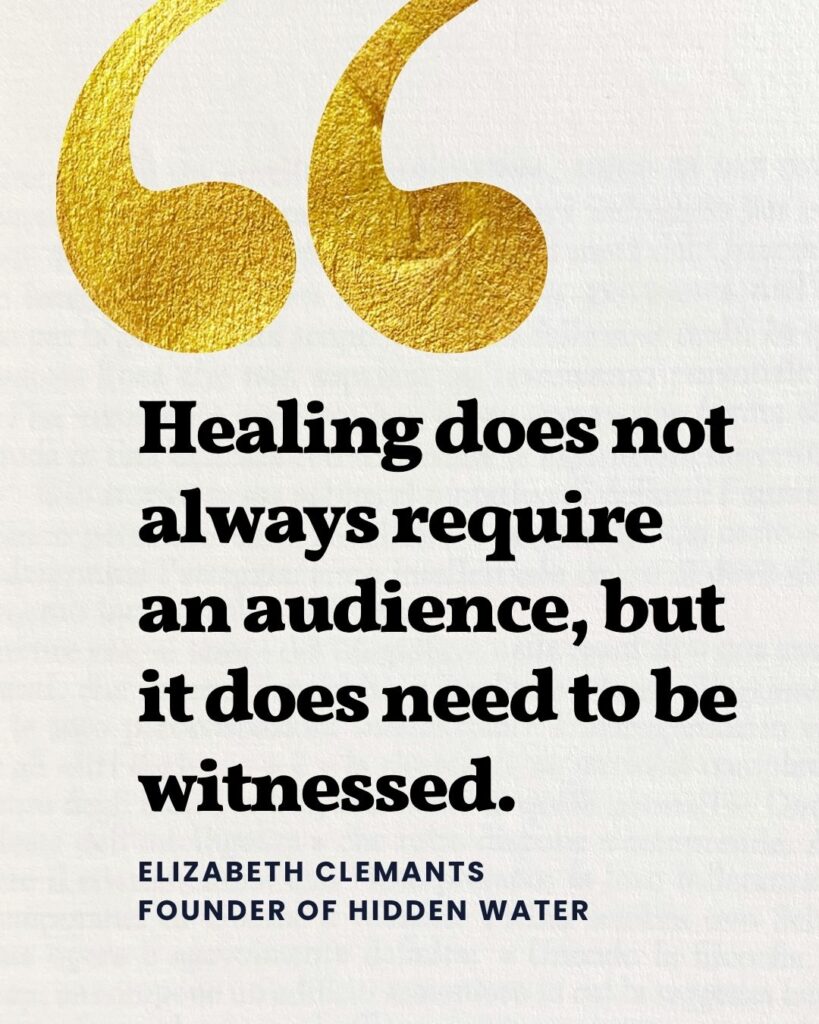
Most women never disclose publicly. Some never disclose at all. Others speak only to one person, in one moment, without ever returning to it again. Healing does not always require an audience, but it does need to be witnessed. It does not always require a formal telling. It does benefit from a listener who can hold the truth without collapsing under it.
Timing, then, is not evidence of credibility. It is evidence of readiness. When a woman speaks about harm decades later, the question is not why she waited. The insight is what has shifted, internally and externally, that makes speaking possible now.
My grandmother’s disclosure did not change the past. It did not alter any outcome. And yet, 90 years later, it changed something quiet and profound in the present. She was saying, in the simplest possible way: I think I am done carrying this alone.
And that was enough.