

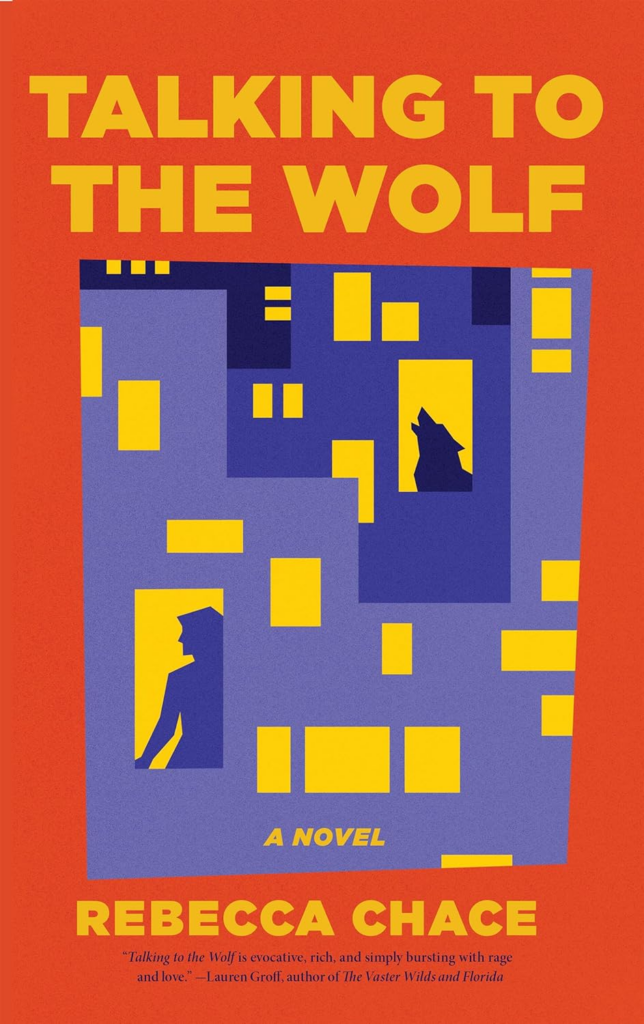
An exclusive excerpt of ‘Talking to the Wolf’ by Rebecca Chace
Enjoy this slice of Talking to the Wolf, which is about a failed rockstar, an awarded scientist, a work-obsessed misanthrope, and a ghost, whose untimely death ruptured the once-solid quartet, steel themselves for their thirty-fifth high school reunion dinner. Set during a surprise snowstorm in New York City the day of the reunion, the novel is a lyrical exploration of female friendship, friend breakups, and reconciliations across decades.
CORA
I am so fucking sick of being dead!
I want to shake the walls, rip up the subway tracks, melt those thick metal wires running through the salty dirt beneath the pavement. I know this city as well as my own body and I counted on my body to be smarter than it was—muscles, veins, legs, wrists, fingers, eyes, tongue. I’ve always been strong. It scared people sometimes, my broad shoulders and muscled arms. Those A & R guys didn’t expect a rugby player in heels. It was funny to watch their expressions change, then scramble to cover it up. But I tried not to smile too much at first; it’s not my job to help them relax. Just another work dinner and it wasn’t raining hard, so I grabbed a Citibike to sweat out the alcohol and sleep better next to the man I didn’t want to leave. I knew I’d make the light, standing on the balls of my feet against on the pedals to go faster. I was nine years old, pumping up a hill before the long glide down the other side, braids flying back with no helmet. Who carries a helmet in an expensive shoulder bag?
I flew through the light and that taxi just kept coming, tires sliding on wet asphalt like a wall of metal. Blaring horn and bike handles twisting down and away. The accident happened so fast, and ever since my body hit the pavement it’s like I’m stuck and unstuck at the same time. I’m caught in the rough first layer of a fresco, lines drawn in that pigment the color of dried blood, my body marked out while the plaster’s still wet, trapped in some unknown geometry of movement and the smell of iron.
I want out and I want back in.
Both ways is the only way I want it.
Where’s Val? She’s the only one who might still hear me. We were the ones who always answered the phone, met at the bar with swollen eyes and a pack of cigarettes, moving in and out of love, first periods, last periods, bullying mothers, disappeared fathers, crazy sisters, children unborn, found, or gone, parents dying too fast or too slow, this apartment, that apartment, an eyebrow raised across a crowded room, laughing so hard we had to clench our pussies or wet our pants, and always my heart driving me like an engine until that sudden snapping shift.
This is not my life.
That’s right, says the undervoice, speaking in a language only I can understand. It’s not your life.
I can’t believe how much time I wasted thinking I was immortal.
I have to find Val. Force her to listen to me even if I don’t deserve it. Even after all those years playing in the clubs, she still has the best ear.
VAL
Val was up late enough to see the snow begin, flecks of mica in the streetlights. She lay on her side watching First Avenue blink out or stay on all night. The sky was stuck on repeat, the east coast gripped by a storm crawling toward New York City, dumping snow instead of moving out to the Atlantic. The wind lay down tracks between the buildings, stars overdubbed by urban glow. There was the scrape of garbage trucks with snowplows attached like the prow of a ship. Val loved their headlight eyes, orange cyclops spinning on top and red taillights showing through the static in the air: All clear! All clear! It comforted her to have these lumbering creatures moving purposefully through the city. Maybe it would snow long enough to shut the whole place down for good.
She closed her eyes, hearing the tonal shifts between late-night car tires and the hollow metal door slam from the bar downstairs as someone put garbage bags out on the street, the thump and rattle of glass and a low murmur in Spanish, the scratch flare of a match to the last cigarette of the night.
Sleepless nights came more often than they used to, but Val was afraid to keep medication in the house.
Why had she said she’d go to her thirty-fifth reunion? High school didn’t matter. Harrison only mattered because it was where she met Cora in kindergarten. Val made it through graduation by the skin of her teeth and disowned the place as soon as she could. But never the two of them. Val used to say that they were the only band she was in that never gigged and never broke up—until Cora broke up with her.
Cora had stopped talking to Val after that lunch Val over rehearsed for, even though she was Cora’s oldest friend; even though Cora had stopped being her manager twenty years ago, when she joined Sony and became a “Suit.” Val had lost her appetite as soon as she walked into the restaurant. Another French bistro in Tribeca with tables on the sidewalk because it was June. Cora had made a reservation for indoors, red leather booth, white tablecloth, thick napkins. Val kept picking at the edges of her omelet; Cora plowed through her steak frites.
“I’ve been sending the new songs around,” said Val. “I’ve even tried submitting to contests, though I’m not exactly an ‘emerging’ artist anymore.” She laughed like it didn’t matter and Cora waved at the waiter.
“Can I have some more mustard?” Cora never put ketchup on her fries anymore.
“I need a new manager, but everything’s changed so much since I left Josh.”
“Josh was an asshole.” Cora pushed her plate toward Val. “I can’t finish these. Want some?”
Val stared at the pile of twisted potatoes, the blood from Cora’s steak turning pink on the white oval plate. “It’s hard without a manager. People don’t even send rejection notes anymore.”
“Really? That sucks.” Cora looked around the restaurant. “How long does it take to pick up a pot of mustard from the kitchen?”
“Do you guys send rejection notes?” Val couldn’t help herself.
Cora’s mouth hardened. “My assistant handles all that.”
“If you could recommend me to someone it might—I mean, you know, somebody younger who’s coming up. Someone you think has good ears.”
“At this point in my career . . .” Cora moved a piece of gristle to the side of her plate with her fork. “It’s more complicated than that.”
The waiter brought the mustard with an apologetic expression. Cora sighed across her plate. “I’m not hungry anymore. You sure you don’t want any?”
Cora picked up one long French fry and reached over her plate. She gently stroked Val’s closed lips with the pointed tip, as if the frite was an extension of her fingers with their perfect nails. Those fingers had been in Val’s mouth before, the two of them pressed tightly against each other in a bathroom stall at the club. Crotch, legs, ass, mouth. In their twenties, they couldn’t get enough.
“Open up,” said Cora, waving the frite in the air, half-serious, half-joking.
Val batted it away so hard it landed on the floor. Cora laughed and pushed back her chair to go to the bathroom. Val forced herself to stay at the table, watching ice cubes jostle against each other in her water glass, not crying, listening to Cora talk about nothing as she paid the check.
i need a break, Cora wrote to her the next day. Texting instead of calling.
we don’t get breaks! Val texted back, before she understood she wasn’t getting an answer.
Cora’s break lasted for months, expanded and changed texture. It won’t last forever, said Sasha. It’s a phase, said Lauren. Was Cora thinking about Val as much as Val thought about her? No, said Sasha. No, said Lauren. Val was too needy, too hungry, she had leaky eyes and a rattling cough. She might be contagious. Who could blame Cora for not wanting to put up with her stench for one more day?
Then came the bicycle and the taxi and Cora stopped breathing on the ninth of October.
As soon as she died, Cora started talking to her again.
Time for the reunion tour said Cora.
Now she wouldn’t shut up.