
Can you burn more calories ruck-cleaning than jogging alone?
For most of my adult life, I did fitness the “right” way. I ran. I trained. I signed up. I remember sitting in my car at 5 a.m. to meet my friend Kerri for bootcamp. We were 22 years old. We both commuted an hour to work after that workout every week. Writing this now makes me smile. Kerri and I had all the time in the world — we were fresh out of college and still living with our parents.
In my late 30s, the early mornings, late-night yoga classes, and long training plans stopped feeling sustainable. Not because I stopped caring about my health, but because the structure of my life changed. I was working. Raising kids. Managing a household. My body also felt different. Workouts that once energized me began to feel like another demand.

Talking with women in midlife, I know this experience is common. Structured exercise often fades quietly. Not out of laziness, but because of fatigue, responsibility, time pressure, and bodies that no longer respond the same way to intensity. I started walking laps in parking lots during my son’s hockey practice with other moms. We talked. We worried. We laughed. It was movement born of necessity and connection, not a plan.
What struck me most was that my movement did not disappear. It just stopped being labeled as exercise. Research supports this shift.
When exercise becomes invisible
Studies comparing physical activity patterns across generations show that modern adults perform significantly less occupational and lifestyle movement than previous generations, largely due to labor-saving technology. Daily movement has declined by roughly 30 minutes over the last century, not because people stopped moving, but because movement became “invisible.”
Our bodies, however, have not changed — they still respond to effort, duration, and consistency.
Why energy expenditure matters more than fitness labels
I’ve always trusted evidence more than fitness trends, which is why I rely on measured energy expenditure rather than narratives about what counts as exercise.
Compendium of Physical Activities is the scientific framework I use to calculate chores energy expenditure in the ChoreFit app. Developed by exercise physiologists to quantify everyday movement, the Compendium assigns metabolic equivalent of tasks values (METs) to hundreds of activities. The Compendium of Physical Activities started in the early 1990s to give researchers a consistent system for measuring the amount of energy used in various activities.
Before the Compendium existed, studies often used inconsistent values, making it difficult to compare results. Since its first publication in 1993, the Compendium of Physical Activities has been updated several times (in 2000, 2011, and more recently in 2024) to include new activities and better data. Over the past 30+ years, it’s become a widely used tool in research, public health guidelines, and even apps and tech that track physical activity (Ainsworth et al., 2024).
One MET represents the energy cost of resting quietly. Activities are scaled relative to that baseline.
Calories burned from daily activities (MET-based estimates)
Calories burned during daily activities can be estimated using MET values from the Compendium of Physical Activities.
While one MET represents resting metabolic rate, activities at 3.0 METs or higher are classified as moderate intensity, according to the U.S. Department of Health and Human Services Physical Activity Guidelines (2018).
Weighted vest exercises around the house: METs from common household activities
• Vacuuming: ~3.3–3.5 METs
• Mopping or scrubbing floors: ~3.5 METs
• Carrying laundry upstairs: ~4.0 METs (or higher depending on load weight)
• Snow shoveling: Often exceeds 5.0 METs
How calories are calculated
Calories per minute can be estimated using the standard formula:
Calories/minute = MET × 3.5 × body weight (kg) ÷ 200
Because calorie burn depends on body weight and duration, two people performing the same task will burn different amounts of energy.
Public health guidelines define moderate-intensity activity as ≥3.0 METs. Many everyday household activities meet or exceed this threshold. When an activity raises heart rate, increases muscular effort, and requires sustained energy, it qualifies as moderate-intensity physical activity under established guidelines.
Chores without load versus chores with load
Here is where the science becomes especially interesting.
Without added load, many household activities already meet moderate intensity thresholds. Vacuuming requires continuous walking and pushing. Mopping and scrubbing involve sustained upper body force, trunk stabilization, and leg movement. Carrying laundry increases lower-body and core demand.
When external load is added, such as a weighted vest, the physiological response increases without changing the movement pattern.

Adding load increases muscular recruitment, particularly in the legs, hips, and trunk. It raises oxygen consumption and overall energy expenditure while preserving low-impact, joint-friendly motion. Research on wearable resistance shows that even modest added weight significantly increases metabolic demand during walking and daily activities, especially in midlife and older adults (Macadem P et al., 2017).
In practical terms, the same chore performed with a weighted vest requires more effort from the same body. Heart rate rises modestly. Muscles work harder to stabilize and move. Over time, this contributes to strength maintenance, bone loading, and cardiometabolic demand without requiring additional time or structured workouts.
This is not about making chores harder for the sake of it. It is about recognizing that load changes the stimulus.
The body adapts to load and repetition, not to whether movement happens in a gym.
Why accumulated movement counts as fitness
One of the most persistent myths in fitness culture is that activity must happen in long, intense blocks to matter. But that’s not always true.
The U.S. Department of Health and Human Services research shows that accumulated moderate-intensity physical activity improves cardiovascular health, metabolic function, and mortality risk, even when performed in short bouts across the day.
Household movement is inherently accumulative. A few minutes here. Ten minutes there. Repeated daily. When tracked accurately, these sessions often meet or exceed recommended activity thresholds across the week.
The problem has never been the movement. The problem has been visibility.
The benefits of wearing a weighted vest in everyday life
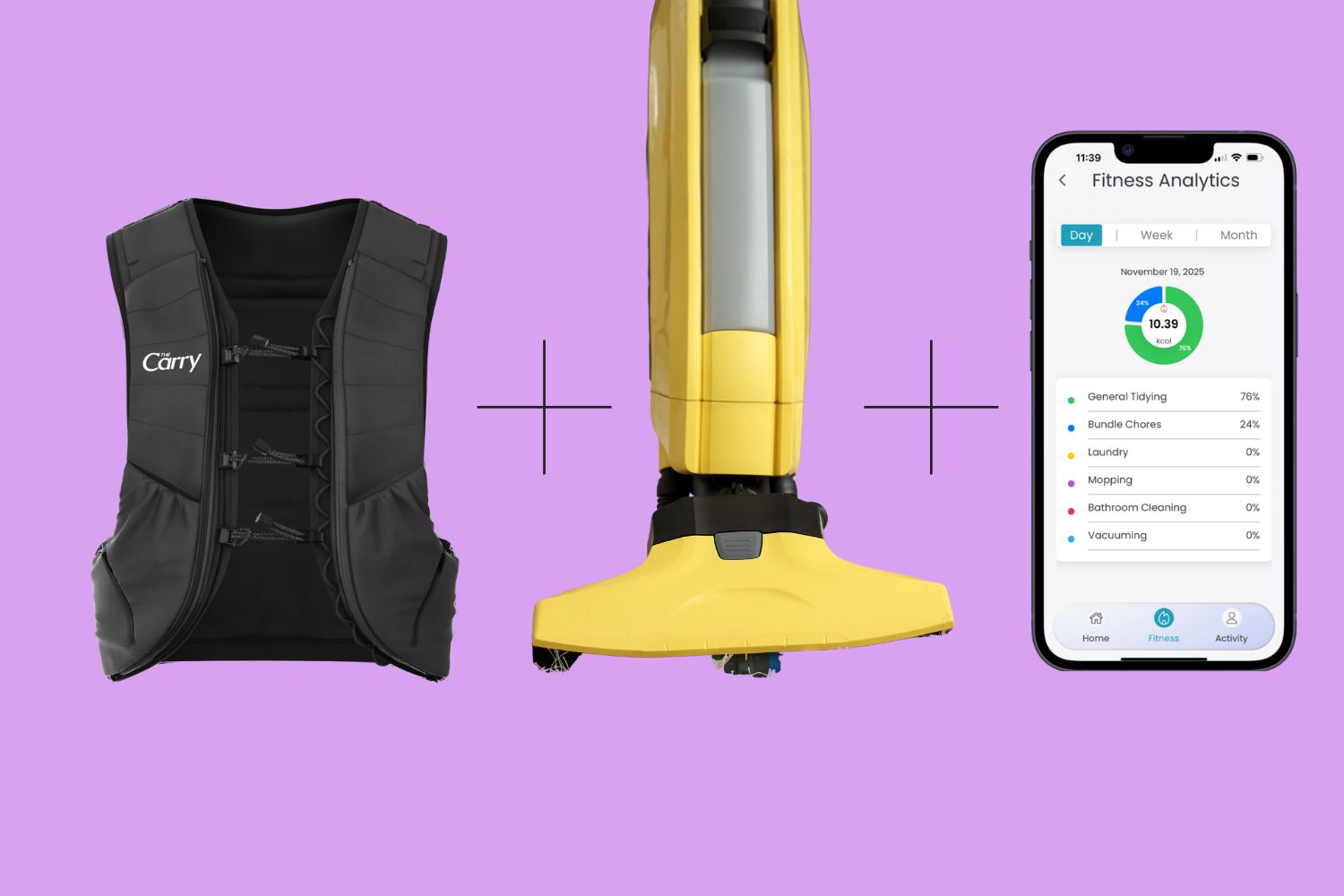
Weighted vests are simply a tool to increase load during movement you already do.
A practical starting point is 5 to 10% of body weight. Movement should feel steady, not strained. Breathing should remain controlled.
Examples include vacuuming with upright posture, carrying laundry upstairs, tidying rooms with repeated squats and reaches, and making beds using lunging and pulling motions.
These movements are multiplanar and functional. With light load, they often cross moderate intensity thresholds without impact (Ainsworth et al., 2011).
Walking, stair climbing, sit-to-stand transitions, wall push-ups, and gentle carries can also be performed with or without a vest depending on comfort and joint health.
No jumping. No rushing. No turning life into training. Just letting effort count.
Why everyday movement is supported by research
The evidence is clear. The body responds to mechanical load, muscle activation, and sustained energy demand. Moderate intensity activity improves health markers regardless of where it occurs. Wearable resistance increases metabolic demand during everyday movement. Accumulated activity contributes meaningfully to long term cardiovascular and metabolic health (Macadem P et al., 2017; U.S. Department of Health and Human Services, 2018).
Household work meets the physiological criteria for real fitness. It always has. It was never acknowledged.
Why I built a way to measure my effort with ChoreFit
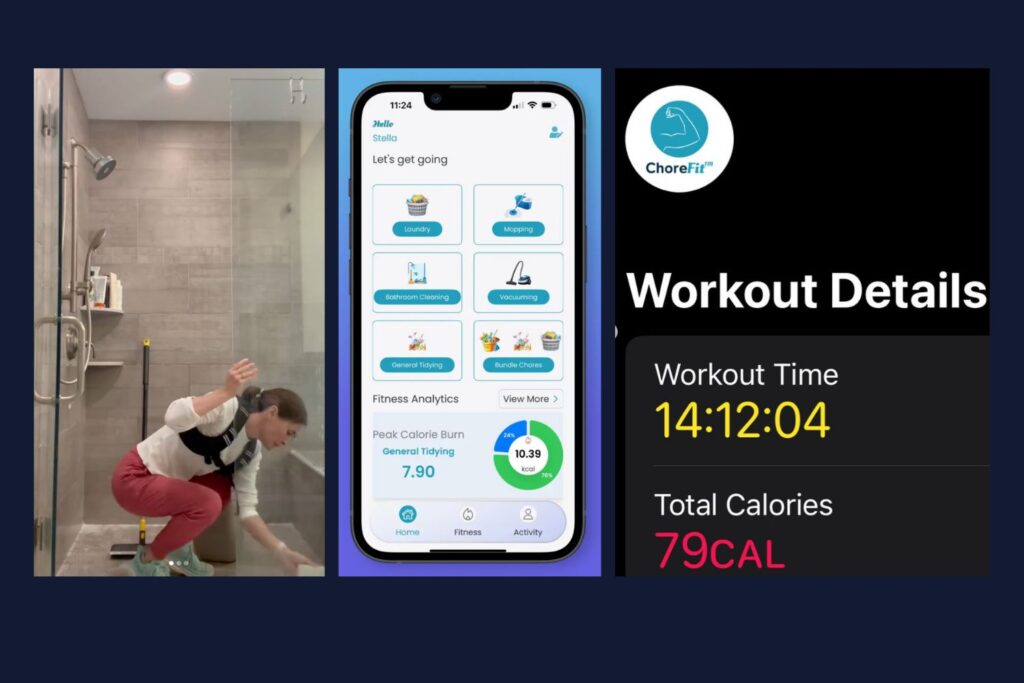
As I approached 50, feeling stuck and unseen in my own effort, I built an app to measure what was already there. ChoreFit tracks household work using Compendium-based energy estimates and integrates with Apple Health. Not to gamify life. Not to optimize every minute. But to validate the movement that already supports our health.
References and sources
Ainsworth BE et al. A brief history of the Compendium of Physical Activities. 2024.
U.S. Department of Health and Human Services. Physical Activity Guidelines for Americans. 2018
Harvard Gazette. Progress does not always mean movement. 2021
World Economic Forum. How housework can improve mental and physical health. 2020

Stella Tamul invents the 1st ‘chores fitness’ tracker app
In November 2025, Stella Tamul launched ChoreFit, the Apple Watch app that uses exercise science, MET values, and energy expenditure to track household movement as real fitness and sync it accurately to Apple Health. Stella says she got the idea for ChoreFit because she wanted movement to feel honest, sustainable, and visible at a stage of life where traditional, more intense fitness doesn’t always fit.