
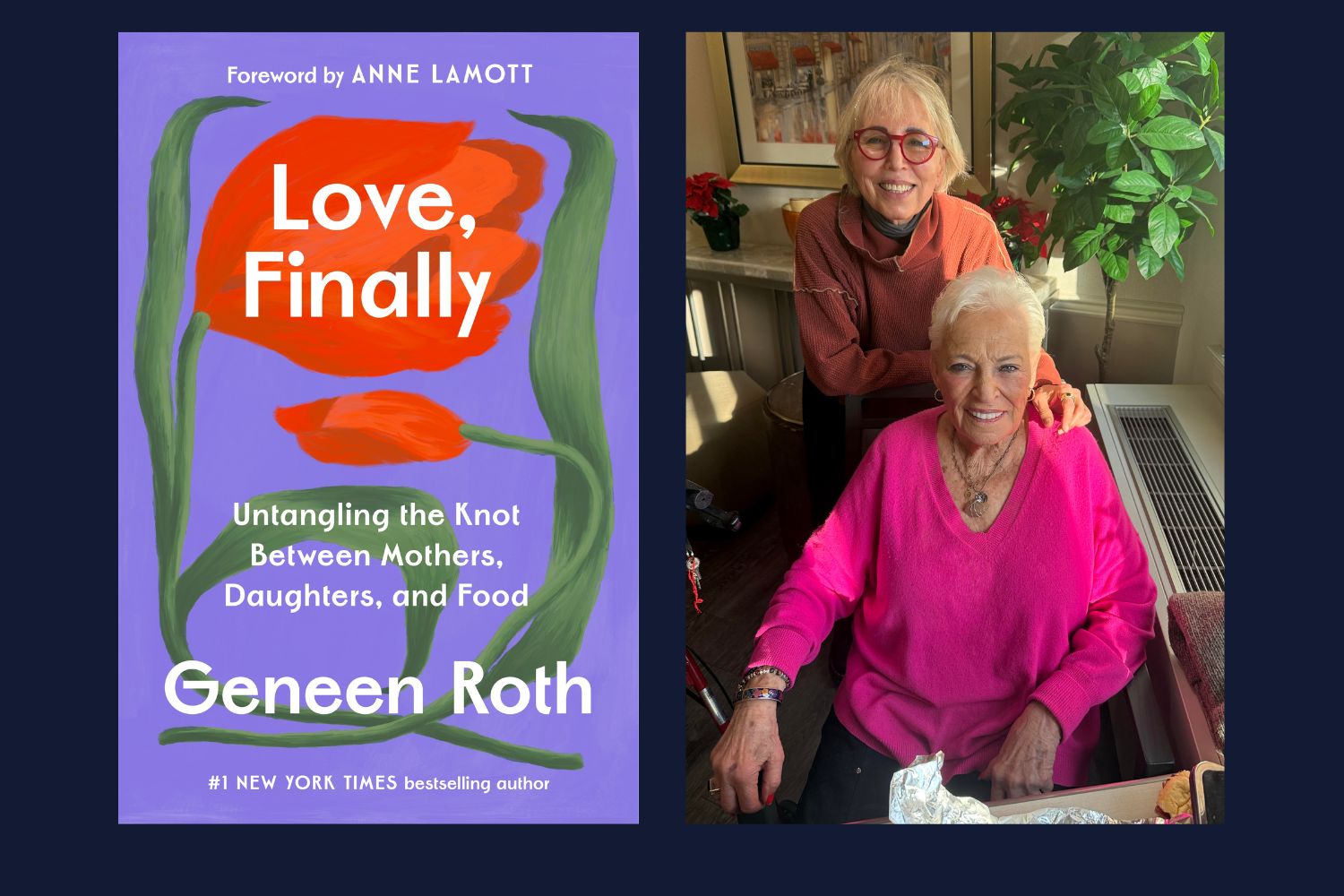
Enjoy this excerpt of Love, Finally by Geneen Roth
Shopping With My Mother
My mother and I are shopping at the Healthy Food Expo in Huntington, New York, on a dolphin-blue day. I am thirty, she is fifty-two. We stop at a booth of tie-dyed turquoise-and-orange-streaked scarves made from hemp. I wrap one of them around my neck.
“Sweetheart,” my mother says, “scarves should be made of silk. Always. Forget hemp. Besides, these striped tie-dyed things are beyond ugly.”
I nod. She’s right. Her sense of style is impeccable. We keep shpatziring — a Yiddish word for strolling.
I love my mother.
I hate my mother.
I think she’s gorgeous with her blond upswept hair and perfectly applied makeup and crisp clothes. Her face is a double ruffled peony in full bloom. You can’t not look. You can’t not be struck dumb by the wide-set eyes, the pouty mouth, the long straight nose. Men twenty years younger than she is who could be looking at me look at her. Whatever women have that command attention, that makes people go silent and gawk when they walk into a room, she has it. My friends tell me they’ve never met a mother like her. My boyfriends stare at her, gobsmacked, mesmerized like automatons.
In an unfortunate roll of the genetic dice, I look like my father. Round face, moon cheeks, short legs. When he and I go places together, he stops anyone — strangers on the street, salespeople — and, pointing at my face, says, “Tell me, whose face does she have?
The Big B, that’s who.” (His name is Bernie.) My mother tells me I have my own style, that my skin is clear and my hair is shiny, but I don’t care about clear skin and shiny hair. I want to look like her.
And so I love her face and I hate that it’s not my face. But there’s more. There’s what happened between us.
We walk up to a bench on the edge of the market.
“Sit,” my mother says, patting the bench on her right side. “Let’s talk.”
We cross our legs, face each other.
“When will I have paid enough for what I did? When do you stop talking about what a lousy childhood you had and get on with the present?” she asks, her voice rising, impatient.
I feel the wall slam down in my chest. I think about saying, “When you admit that it happened,” but I still don’t have the courage to stand up to her.
The crack of her hand on my face when I talked back to her. Her wild eyes as she backed me into a corner. Her hands with the red-painted talons. The welts left on my arms, face, legs.
She continues, “Everyone hit their kids in those days. Bobbi and Lil and Iza and Rose. Every kid you know got hit. That doesn’t amount to being beaten.”
“I was so lonely as a kid,” she says. “And then I met your father, who was my first boyfriend. I was fat and felt ugly and no one else had shown any interest in me. And when your father asked me to marry him, I said yes, and that I wanted two things: a television set and a baby. Nine months later you were born.”
I don’t want to hear what a terrible childhood she had. I want her to say, It’s true, I beat you.
I want her to say, I am sorry.
I want her to say, You’re right, I was so focused on myself I couldn’t focus on my children.
It’s like wanting a cat to bark, as Byron Katie says, but it will take fifteen more years before I understand that.
My mother says, “I never felt loved by my mother. She yelled at me because my fat legs rubbed together until they were raw and we had to buy expensive cream to make them better. She told
me I was so fat I would never find a husband, and then when I met your father, she told me that whether I loved him or not — I didn’t — I needed to get married right away because she and my
father would no longer support me going to Long Island University. Then she made fun of your father. She said, ‘Most people have thirty-two teeth in their mouths. Why does he look like he has sixty-four?’”
I’ve heard these stories before, and the same thing that happened to me when she hit me happens to me now: I become stone-faced.
“So, call me a criminal,” she continues. “Call me a terrible mother when I put you on your first diet at age eleven because I wanted to spare you the pain of what I went through. I was trying
to help you, for God’s sake. Which is why I took you to get those diet pills when you were fifteen. How was I to know that you would get addicted to those? Or that you would spend seventeen years with an eating disorder, gaining and losing a thousand pounds?”
I look at my mother’s beautiful face and don’t feel anything except that she really knows how to apply eyeliner. Which isn’t to say that I don’t understand her frustration. The days of hitting and screaming are over.
She is not the same woman who hit me with a stick, lied, and cheated on her husband. I can no longer figure out if the years I’ve spent in therapy have inscribed the “I was a victim of abuse” deeper by constantly talking about it or if talking about it is releasing it. Two therapists suggested I stop talking to my mother, urged me to cut off all contact. Another therapist told me I was raised by wolves and that I was lucky that I hadn’t become permanently deranged. But that might be because I tell them only half the story.
The way when I gained eighty pounds and was positive she would be disgusted at how fat I had become, she said, “You’re so beautiful. You always were.”
The way when I quit premed courses and despaired that I would never figure out what I wanted to do, she said, “I believe in you.”
The way she loved the beauty of dinner plate dahlias and crisp white shirts.
A few months later, she calls me. “Darling,” she says. “I’m sorry. I’m sorry for all the times I called you fat. And for telling you that your ankles were like piano stools.
“And there’s something else I want to say before it’s too late: I’m sorry for not being there for you and your brother. I was so lonely and so absorbed in my own problems that I wasn’t interested in you or what you were going through. I know I was a terrible mother, just like my mother before me. Just like my sister, who dropped Linda at an orphanage when she was two and left to be a stripper in New Orleans.
“I don’t want to die with you being angry with me. Can you ever forgive me?”
Forgive her.
I tell my brother that she asked for forgiveness and he says, “Yeah, right. Forget it. She’s lying.”
I tell my best friend from college that my mother asked for forgiveness and she says, “Don’t believe her.”
I tell my first therapist that my mother asked for forgiveness and she says, “She doesn’t mean it. Why are you still talking to her?”
I tell my second therapist that my mother asked for forgiveness and she says, “I thought you cut off contact with her years ago.”
I tell my mother I think it is brave to ask for forgiveness. I tell her that since she has always insisted that she was a good mother, I need some time — a few days, a week, a few weeks — to let her words settle.
Like everyone whose mother is still alive, I cannot remember a minute, an hour, a day without her. She is the beginning, the middle, the end of every story I’ve told even when I don’t mention the word mother. She is my “root guru,” the one from whom I received the direct teachings about what I needed to do, say, eat, wear, weigh, to take up space, to belong here. Even when I don’t mention her, she is the unseen force behind every story I’ve written or told. I’ve grown like an antitropism away from her harsh light.
But I do not want to keep living in reaction to her.
They say that trauma is passed through five generations.
I didn’t know my great-grandmother, and my mother doesn’t remember her except that she made blintzes and the members of her temple in the Bronx came out to pay their respects to her hearse on its way to the cemetery. And I know she escaped Russia during the pogroms and so she must have been traumatized by the persecution and the two years it took, over land and in freight boats, to get to Ellis Island. And I know my mother’s mother was not kind, and that when my aunt June died, Lola said it was the happiest day of her life.
Forgive my mother?
What would it take? And is it even possible to drop the wall of resentment that slams down the second I hear her voice?
After my mother asks me to forgive her, I decide that now might be the time.
We’re honored to publish this excerpt of Love, Finally by Geneen Roth on The Midst. The Midst is a community-driven platform leaning into the messy middle of life pivots, career and relationship upgrades, perimenopause, building businesses, and so much more. We help women play by their own rules to become the women they are meant to be. Subscribe to our free newsletter on The Midst Substack.