
Stop fixing yourself: Life coach Wendy Perrotti on why women get stuck
Wendy Perrotti had a hot flash pitching a 30-year-old tech founder in a 9,000-degree Manhattan conference room. Her face flushed red. Her credibility seemed to evaporate right there on the spot. She didn’t get the job.
Fifteen years later, she’s coaching the women who are still fighting to be taken seriously—at every stage of life, in every room that no longer quite reflects them back.
Since 2014, when most people still thought “coach” meant basketball, Wendy’s been doing intimate, consequential work with founders, executives, and women navigating midlife. Her practice centers on a deceptively simple question: What if the problem isn’t you? What if you’ve simply built a life around handling too much—too much emotional labor, too much self-monitoring, too much being reasonable—and your body, your mind, your marriage, or your inner voice is finally telling you it’s time to stop?
In this conversation, she unpacks the pattern that keeps capable women stuck, why monetizing your own genius is so much harder than selling someone else’s, and how that hot flash in Manhattan actually taught her something worth far more than the client she lost.
Luckily for us, we’re thrilled that Wendy is guest-speaking at an upcoming Midst Mastermind meeting, and luckily for you, she goes pretty deep into her framework in this interview.

The Midst: Before coaching, you spent your 20s as the national disaster spokesperson for the American Red Cross — flying out on a moment’s notice whenever “the wind blew somewhere.” What made you walk away from that, and how did helping run your husband’s family business (bookkeeping, marketing, sales — all of it) end up preparing you for the career you have now?
Wendy Perrotti: I believe that everything we do prepares us for everything else we do. Our lives are not linear — they’re rather sprawling.
The experiences we have, the work we do, the things we survive, what we take on (and what we don’t) — all of it shapes what comes next. The big question is whether we let that experience harden into fear and certainty, or whether we metabolize it into wisdom and curiosity about what else is possible.
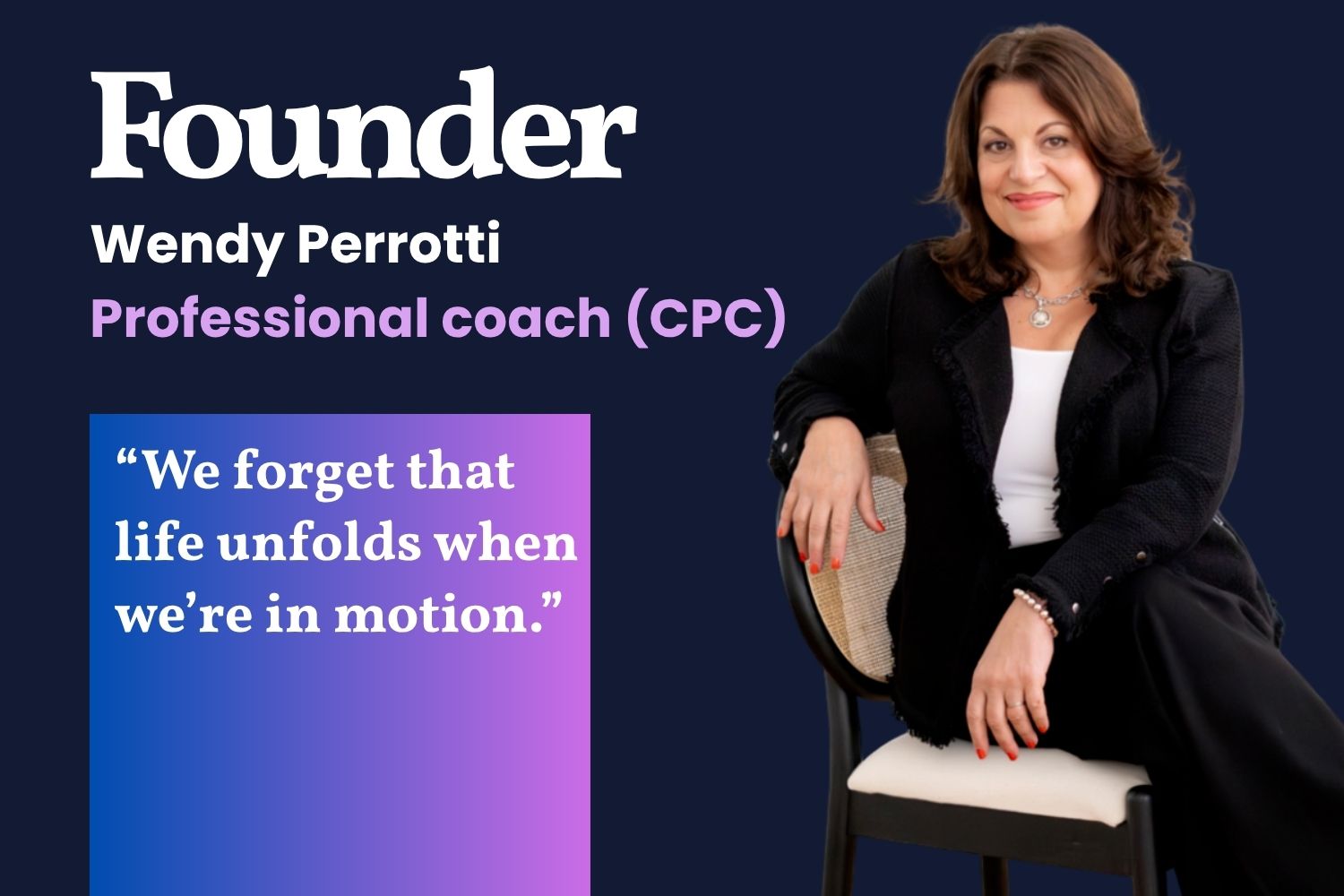
My time with the Red Cross taught me a lot about mission, resilience, community, and courage. It taught me about the importance of communicating with people in ways that they could hear. Most importantly, that time taught me that life unfolds when we’re in motion.
I didn’t start as a national spokesperson. I didn’t even start in communications. I started as a service provider, working with people displaced by fire in impoverished neighborhoods.
I was, and still am in many ways, a shy and introverted person. But I was also good at speaking, and the mission mattered deeply to me — in short order, I found my way into new roles and those roles led to being one of a small team of national spokespeople.
This is something I think we forget about after 40 or so: that life unfolds when we’re in motion. It seems like with every passing year, we become more attached to making the “right” choice and we end up passing all the entry points that may end up getting us there.
That time in my life taught me something else that I think about all the time. There is a kind of pushing ourselves that’s absolutely worth it, and a kind that is absolutely not.
Pushing myself in that role was worth it because it was aligned. It asked something brave of me, but it did not ask me to betray myself. But as I got closer to having children, I knew that I didn’t want my experience of being a mom to include having to get on a plane with no more than an hour’s notice whenever the wind blew somewhere. There was a lot of opportunity for me at the Red Cross, and it would have been easy to keep following that path because it felt meaningful and I loved the work. But it no longer fit the life I wanted to build.
So I walked away.
At first, I thought I might stay home with my children and have a small wedding cake business. I actually went to culinary school and became a pastry chef. But life had other plans, as it often does. My husband’s family business was growing, he needed help, and I needed something that was not only motherhood, even though motherhood mattered deeply to me.
So I stepped in and did whatever needed doing. I learned bookkeeping, even though I was the girl who never once balanced her checkbook. I learned QuickBooks and marketing. I designed direct-mail pieces, created tradeshow materials, joined chambers and industry organizations, and built out a real business-to-business presence.
Eventually, I even became the company salesperson, which was the last thing I wanted to do. But… I learned how to sell and by the time I left, I was selling seven-figure contracts.
So yes, the practical preparation was enormous. Communications, marketing, sales, bookkeeping, forecasting, business development, client relationships, public speaking, crisis response. All of that prepared me to build my own business.
But the deeper preparation was more personal.
Both the Red Cross and the family business were mission-driven for me. I cared about both. I was proud of both. But there was an important difference.
At the Red Cross, the work belonged to me. It was part of my own evolution. In the family business, even though the work was meaningful and values-aligned, so much of it was in support of my husband, my children, and our family life. There is nothing wrong with that. It was a choice I made with love. But over time, I began to feel the absence of the part that was mine.
And I think many women understand that.
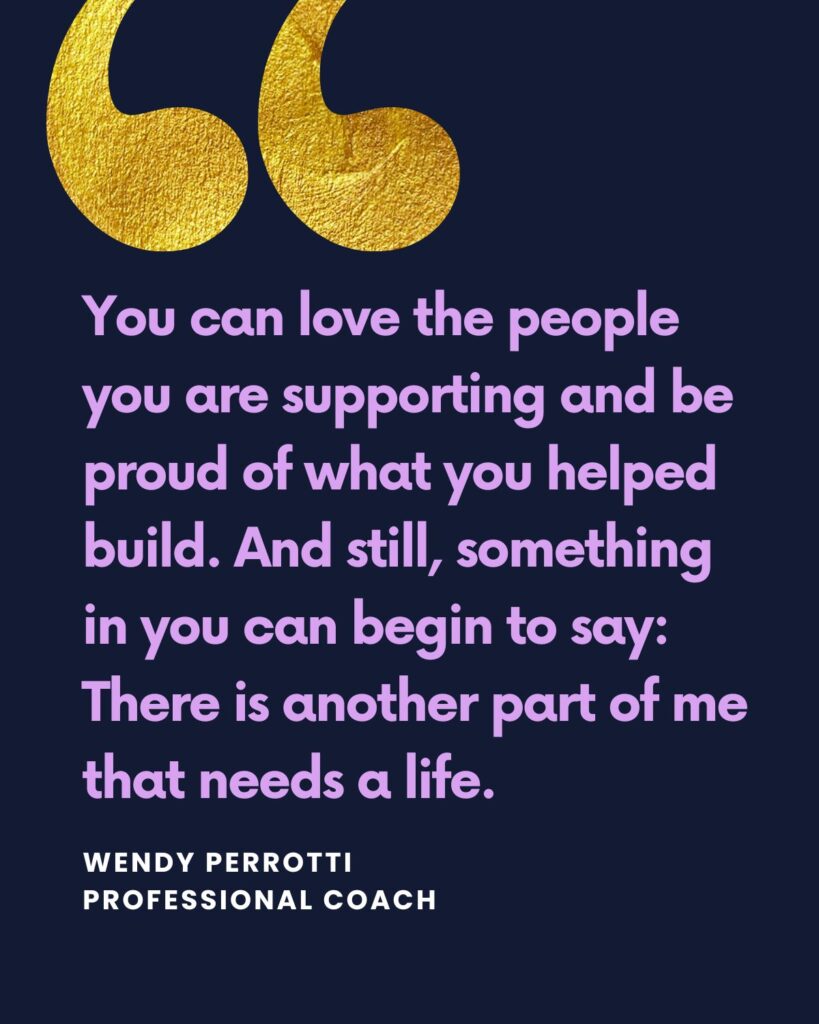
You can be doing good, important, generous work. You can love the people you are supporting. You can be proud of what you helped build. And still, something in you can begin to say: there is another part of me that needs a life. That was really the beginning of my path into coaching.
It was not a clean reinvention. It was several years of searching, studying, questioning, learning, and slowly recognizing the work that had been under the surface all along. Coaching became the place where all of those earlier pieces came together: crisis, communication, resilience, business, identity, visibility, family, mission, and the question of what happens when a capable woman realizes the life she has built no longer fully contains her.
That is still the center of my work now.

You told me about pitching an executive coaching program to a 30-something tech founder in Manhattan, mid-hot-flash, feeling it “discrediting” you in real time. You didn’t get that client — but you were building the exact business you run today. Looking back, what was that season of your life actually teaching you?
Good lord, it taught me so much. I think mostly that midlife is not just a transition. It is a reckoning.
There is the body reckoning, of course. The moment when your body starts doing things you did not approve, schedule, or anticipate. A hot flash in a Manhattan conference room, while you are trying to appear calm, polished, and credible, is a quick way to learn that control is a dance we do with all of the external (and in the case of a hot flash, internal) chaos that surrounds us every day. It’s not something we grip with both hands.
But there is another reckoning happening at the same time. The world around you starts to feel different. Younger. Faster. Smarter in some ways. Greener in others. Sometimes brilliant, sometimes ridiculous. You can find yourself looking around and thinking, Wait, do I still belong here? Do I know how this works anymore? Am I aging out of rooms I used to know how to enter? And I think that’s where midlife tries to shut us down — but it’s actually a huge opportunity to expand and grow.
It is very tempting to respond to that discomfort by becoming brittle. To decide the younger people are all foolish, the new ways are all shallow, the old ways were all better, and the room has somehow become misaligned for us. That is one way to protect ourselves from the vulnerability of not feeling quite as fluent as we once did.
But there is another way.
We can let midlife teach us a different kind of presence.
Not the kind that depends on being the youngest, sharpest, smoothest, most impressive person in the room. Not the kind that collapses the minute our body has a plan of its own. A deeper kind of presence. One that can be humbled without being humiliated. Curious without being performative. Open without pretending everything is easy.
I didn’t get that job. In fact, I think I packed up and hurried my red-faced self back to the train before the meeting ever even closed.
But looking back, I think that moment gave me something more useful than the job would have. It showed me that I could survive being visibly human. I could be awkward, flushed, uncertain, disappointed, possibly even make an ass out of myself and still not be inherently diminished in any way.
That is a lesson I use constantly in my work now.
Because so much of midlife is learning how to stay open in rooms that no longer reflect us back in the same way. How to keep participating when we are no longer sure we know all the rules. How to let younger people be young without making it mean we are irrelevant. How to honor what we know without calcifying around it.
The goal, I think, is not to stay current by chasing every new thing. And it is not to retreat into superiority (or inferiority) because the world has changed.
The goal is to remain open enough – hold enough self trust – that our wisdom leads rather than merely our experience.
You’ve been coaching full-time since 2014 — back when, as you put it, telling someone you were “a coach” made them think basketball. What’s changed most about the coaching industry since then, and what hasn’t changed about the women who come to you?
When I started coaching full time in 2014, I still had to explain what coaching was. If I told someone I was a coach, there was a decent chance they thought I meant for some kind of sport.
That’s changed completely.
The coaching industry has exploded. There are so many more coaches now, especially women. Some days it feels like there may be more women who are coaches than women who are not. And within that, there are people doing extraordinary, thoughtful, deeply useful work.
There are also a lot of kind-hearted, well-intended people who have gotten some very bad advice about what it means to be a coach.
That is the part that concerns me.
Coaching is intimate work. People come to us with their lives, their patterns, their fears, their relationships, their hopes, their decisions, their shame, their longings. That requires skill. It requires training. It requires ethical grounding. It requires knowing the difference between coaching, advice, therapy, consulting, teaching, and marketing.
I care a lot about education, certification, and credentialing, not because credentials make someone wise, but because they indicate that a person has at least submitted themselves to some standard of practice, supervision, ethics, and professional development. I hope that becomes something clients understand to look for.
What’s also changed is that coaching has become tangled with a very aggressive marketing culture.
A lot of coaches are being taught that their value is measured by their ability to sell high-ticket programs, create urgency, and push people into decisions. I think that has done real damage to the reputation of the industry. At its best, coaching doesn’t just change lives; it has the potential to shape culture and elevate consciousness.
Unfortunately, the industry is louder, bigger, more saturated, and in some corners, much more performative than it used to be.
What hasn’t changed are the women who come to do the work.
The surface circumstances change, of course. The language changes. The cultural context changes. The platforms and pressures change. But underneath all of that, women are still asking the same very human questions.
Who am I now?
What do I want?
What am I carrying that was never really mine?
Can I trust myself?
Is it too late?
What will happen if I tell the truth?
What will happen if I change?
I often think that if we had known our great-grandmothers as intimately as we know our closest friends, we would recognize so much more than we expect. Different clothes. Different constraints. Different rooms. But the fears, the longings, the compromises, the private hopes, the desire to be known and to belong to oneself – I don’t think those are new.
So yes, the coaching industry has changed enormously since 2014.
But what good coaching does hasn’t changed at all.
This stopped me cold: you said women are culturally conditioned into a “fixing” mindset — that something is always broken, lacking, in need of improvement — in a way men simply aren’t taught to internalize. Where do you see this showing up most in the women you coach, and what does it look like to unwind it?
I see it everywhere. And I want to be careful here, because there is nothing wrong with growth. I have built my life around growth. I believe in self-awareness, responsibility, repair, practice, and change.
But there is a fixing mindset that women are trained into very early. It teaches us to assume that if something feels hard, disappointing, uncomfortable, or misaligned, the first place we should look is at ourselves as the problem.
Before we ask: What’s going on here?
We ask: What’s wrong with me?
Before we ask: Is this life actually shaped for who I am?
We ask: How do I become easier, better, calmer, thinner, more productive, less sensitive, more confident, more desirable, more successful, more grateful?
That is where I see it most.
Women come to coaching because they are exhausted, resentful, foggy, indecisive, overextended, or quietly unhappy. But often, they do not arrive saying, “Something in my life is no longer aligned.”
They arrive saying some version of, “Why can’t I handle this better?”
That sentence is a doorway.
The problem is never that she can’t handle her life. The problem is that she has built a life around handling too much.
Too much emotional labor.
Too much responsibility.
Too much self-monitoring.
Too much being reasonable.
Too much being grateful for things that no longer fit.
Too much making everyone else’s needs clear while keeping her own vague enough not to inconvenience anyone.
And then when her body, her mood, her marriage, her work, or her inner life starts to protest, she assumes the protest means she needs to be fixed.
That is the part we have to unwind.
In my work, unwinding it starts with changing the question.
Not “What’s wrong with me?”
But “What is the pattern?”
What has she been trained to carry?
What does she believe she has to earn?
Where is she confusing loyalty with self-betrayal?
Where is she calling something responsibility when it is actually fear?
Where has she made herself useful instead of self-possessed?
Where is her body telling the truth before her mind is ready to say it out loud?
When we learn to ask and answer these questions we move out of shame and into objective self-awareness. And the kinds of growth and evolution most women are looking to create require objectivity.
We are not trying to turn her into someone new. We are helping her see what has been organizing her life beneath the surface. Because those patterns drive what got her where she is today. (The bad and the good.)
Sometimes that means recognizing an old people-pleasing pattern. Sometimes it means seeing how much of her ambition has been shaped by proving. Sometimes it means admitting that a role she chose with love has become too small. Sometimes it means telling the truth about a relationship, a career, a body, a season, or a dream she has been trying very hard to outgrow gracefully.
And then, from there, we can begin to make different choices.
Not dramatic choices necessarily. Not burn-it-all-down choices. I can’t say this strongly enough, you do not have to sacrifice what you love about your current life in order to grow into the next incarnation of you.
You made $14,000 your first year as a full-time coach — even after years of selling million-dollar contracts for someone else’s business. Why is it so much harder for women to sell their own value than someone else’s, and what finally changed for you? (You mentioned once running a group called Money Mindset Momentum specifically because every woman you coached got stuck at monetization — I’d love for you to unpack that.)
It was humbling. And by humbling, I mean horrifying.
On paper, I should have been fine.
I had already learned how to sell. Not theoretically. I had sold seven figure contracts for our family business. I knew how to market, write copy, design materials, build spreadsheets, manage books, forecast revenue, talk to prospects, and follow a sales process. And I was good at the actual service I was offering.
So I thought: how hard can this be?
Very hard, apparently.
I made $14,000 my first year as a full-time coach.
What I learned very quickly is that selling something that belongs to someone else is completely different from selling something that feels like it comes from your own heart, mind, body, experience, and soul.
When I was selling for the family business, I believed in the product. I believed in the company. I worked hard. But I was not asking someone to evaluate me. There was a little bit of space between my identity and the offer.
When I became a coach, that space disappeared. Now the thing I was selling was connected to my presence, my insight, my skill, my care, my way of seeing. And that made the whole thing much more exposing.
I also discovered very quickly that I was not alone. Almost every woman I coached who was starting a business, building a side project, selling a service, launching a creative venture, or trying to monetize her work hit some version of the same wall.
She could do the work.
She could care about the work.
She could often talk beautifully about the work.
But the moment money entered the room, sh*t got complicated.
That is why I eventually ran a group called Money Mindset Momentum. It came from seeing the same pattern over and over again. Women were not getting stuck because they were lazy, unserious, or bad at business. They were getting stuck because they had internalized a values equation that was completely off.
On one side of the equation, many women have been taught to give freely, make things easier for people, cut a deal, be generous, be accessible, be understanding, be grateful if anyone wants what they offer at all.
On the other side, many women also struggle to invest in themselves. They will pay for what their children need. They will pay for what their partner needs. They will pay for the house, the family, the dog, the emergency, the practical thing, the responsible thing. But when something is solely for their own growth, support, development, pleasure, or becoming, suddenly the bar gets much higher.
Maybe later.
Maybe when things settle down.
Maybe I should be able to figure this out myself.
Maybe I’ll just do the smaller thing.
Maybe I’ll get the TJ Maxx version.
And to be clear, I am not talking about frugality. Frugality is wise and beautiful. I am talking about the reflexive devaluation of what women offer and what women need.
We experience it on both sides of the transaction. We struggle to charge appropriately for our own work, especially when that work feels personal, creative, intuitive, relational, or hard to quantify.
And we struggle to pay for support that benefits only us, especially when we believe the problem is something we should be able to handle on our own.
That is the deeper pattern.
The loudest corner of the coaching industry tries to solve that by telling women to “own their worth” and charge enormous prices pulled out of thin air. I think that creates its own distortion. Your worth is not your price. A $50,000 offer does not make someone more worthy than a $500 offer. That is not how worth works.
But the opposite distortion is also harmful. Inch by inch, penny by penny, waiting until you feel fully legitimate before you charge real money, is not noble.
What finally changed for me was not that I became a slicker salesperson.
It was that I became more objectively self-aware.
I had to separate my worth from my pricing. My worth was never on the table. The question was not, “Am I worthy enough to charge this?” The question was, “What is the value of this work in the marketplace, at this stage of my experience, with this level of skill, for this kind of client?”
Once the questions changed, that allowed me to stop treating pricing as a referendum on my value as a human being and start treating it as a business decision. And of course, that changed everything.
When women can do that, they show up differently. Not apologetic, grasping, or, god forbid, over-explaining.
Just clear.
This is what I do.
This is who it is for.
This is the level of skill and care I bring.
This is the value of the work.
This is the price.
That kind of clarity is powerful because it is not about convincing people. It is about standing in right relationship with your own work.
And I think that’s something that many women are still learning.
Your work spans executive coaching for venture-backed startups with Mary Walsh, Camp Reinvention with Dana Hilmer, content and “Positive Mornings”with Leslie Jane Seymour’s Covey Club, and now your own Substack and coaching groups like Manifest. What’s the throughline connecting all of it?
The throughline is helping people see themselves more clearly at the moment when the old way of doing things is no longer working. That has looked different in different rooms. With executives and venture-backed startups, the work is about agility, leadership, decision-making, communication, emotional intelligence, and the pressure of being navigating all those areas at once in incredibly faced paced, high-stakes environments.
With Camp Reinvention, it was women in midlife asking: What now? Who am I if the roles that organized my life are changing? What do I actually want this next chapter to look like? With Covey Club and Positive Mornings (launched during the pandemic), it was about creating a regular place for women to pause, reflect, laugh a little, tell the truth, and navigate an uncertain time from a more grounded place.
Currently I work almost exclusively with women in their 40s, 50s, 60s, and 70s through private coaching and group coaching programs (like Manifest and Liminal). The work is always about helping women see what has been organizing their lives beneath the surface, move through the uncertainty of transition, and begin creating a path that fits who they are becoming instead of continuing to reshape themselves for spaces that no longer do.
I’ve recently created a Substack, Reclaiming Muchness. So the same body of work has a written landing place. It gives people somewhere to recognize themselves, slow down with the questions underneath their questions, and begin discerning what they may need in order to move forward in their own lives.
The rooms have looked very different over the years. But the work underneath has been remarkably consistent.
I am interested in the moment when a capable person realizes she cannot simply think, perform, please, achieve, or muscle her way into the next version of her life.
That moment can happen in a boardroom. It can happen in a marriage. It can happen after the kids leave home. It can happen while building a company. It can happen in a quiet, ordinary morning when someone realizes she has been living a life that technically works, but no longer feels fully true.
My work is about that moment.
Your book series, starting with The Little Book of Finding Yourself, promises to help women “unlock buried brilliance.” Who is she — the woman standing at what you call the crossroads — and what do you want her to feel by the last page?
The Little Book of Finding Yourself series is actually a tabled project. It made way for other things.
One of those things was a passion project with my brother: a series of picture books for grown-ups.
We published the first one last year.
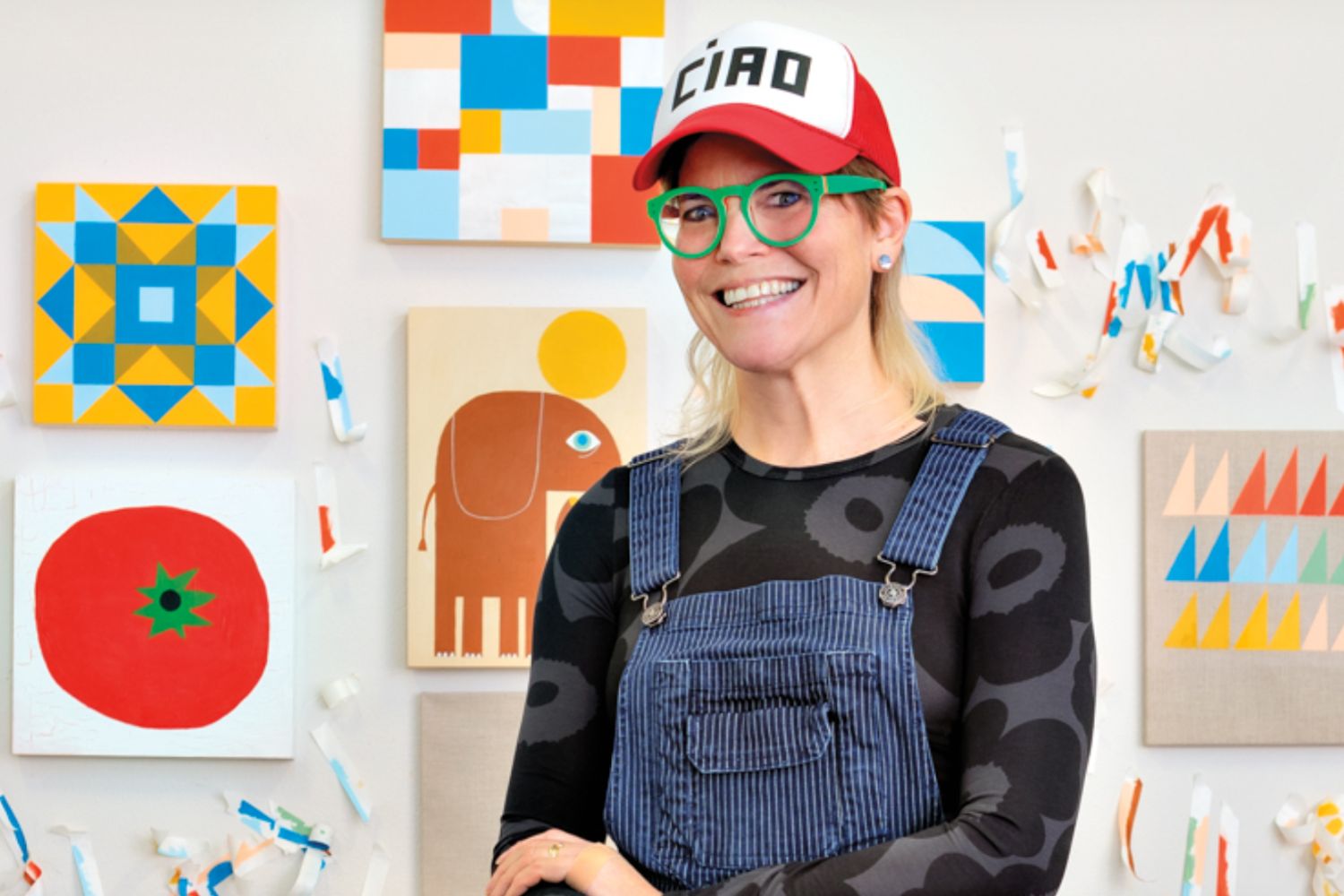
Keep the Tomato: A Grown Up Picture Book for People Pleasers is about how an instinct for generosity and love can slowly turn us into over-givers and pleasers that feel greedy or selfish holding anything back for ourselves
It is not a traditional coaching book. It is more like a little mirror. A funny, illustrated reminder that the things we are about to give away may be the very things we need to keep.
My brother and I had a ball making it. It was joyful and strange and meaningful in all the best ways. And we hope there will be more.
Contact Wendy Perrotti
Reclaiming Muchness on Substack
It’s a tough job, but somebody’s got to quit it.
Wendy Perrotti is a member of The Midst Founder network. Learn about benefits and how to join here.