
The new rules of building strength after 45
I spent my 20s building a fitness app around a simple promise: show up, push hard, and your body will answer. It worked, for millions of people. Then I got older, and the same formula quietly stopped working for me. Recovery took longer, injuries crept in, and willpower alone stopped covering the difference.
If you are somewhere past 45 and the routines that always delivered suddenly do not, you’re not imagining it. Your body changed the rules without telling you.
Here is what changed, and the four new rules that work with the body you have now:
It’s not your discipline. It’s the math.
The fitness industry is obsessed with the 20-year-old version of you. Most of what it sells is built for a body that recovers overnight, responds to any stimulus, and forgives every skipped meal.
The body after 45 keeps a different ledger. And the first surprise in that ledger is good news: muscle mass itself disappears far more slowly than the headlines claim. Even at 75, studies that measure the same people year after year find women losing well under 1% of muscle mass per year.
Strength is the number that moves. Measured in the same people, strength declines two to five times faster than muscle mass. You can look almost the same in the mirror and be measurably weaker on the stairs, because what changes first is not the size of the muscle but how well it works.
That gap explains the frustration. Sound familiar? More cardio and fewer calories, the old go-to answer, does not touch it. Strength has to be trained on purpose now.
What actually changed after 45?
Three things.
First, your muscle got harder to convince. Researchers call it anabolic resistance: the same training and the same protein produce a smaller muscle-building response as we age. A meta-analysis of 49 controlled trials found that the extra muscle gained from protein shrinks steadily with age.
Second, recovery became the bottleneck. A workout is only a demand. The actual rebuilding happens in the sleep and the days between sessions, and that machinery slows down. The session your 30-year-old body absorbed on six hours of sleep now needs real recovery to pay off.
Third, for women, the hormonal shift of perimenopause rewrites body composition at the same time. The strength story runs on the same clock as what that transition does to your midsection.
None of this closes the door. It means the freebies are gone: what a younger body handled on its own now has to be planned.
New rule 1: Make strength the main event
For decades the default advice for women was cardio first, weights maybe. After 45, that order flips. Lifting stops being an optional add-on for people who like gyms and becomes the thing that decides how the next twenty years feel, which is exactly why The Midst has been telling readers to start now.
Two changes matter more than whatever the program is called.
Load over burn. A workout that leaves you shaking from tiny weights and endless repetitions mostly trains your tolerance for the burn. Strength grows when the last two or three repetitions of a set feel genuinely heavy, with weights you can control and technique you trust. The burn is not a scorecard.
Patterns over body parts. Build your sessions from four movements: a squat, a hinge, a push, and a pull. Those four cover almost everything life asks of a body, from floors to stairs to suitcases. Everything else in a strength session is decoration.
New rule 2: 30 to 60 minutes a week is the sweet spot
A meta-analysis of 16 cohort studies found that muscle-strengthening activity was associated with a 10 to 17% lower risk of early death, heart disease, cancer, and diabetes. For early death, heart disease, and cancer, the largest risk reduction came at roughly 30 to 60 minutes per week.
Not per day. Per week.
More than that is fine if you love training. But the data does not demand it. Two focused half-hour sessions clear the bar, and the question is no longer where to find five free evenings. It is which two you already have.

New rule 3: Feed the muscle you’re asking for
Training tells your body what to build. Protein is what it builds with. And this is where the math moved most, because of the anabolic resistance above: the older we get, the less the body builds from the same portion.
The standard recommendation of 0.8 grams of protein per kilogram of body weight exists to prevent deficiency, not to build anything. For adults under 65 who lift, trials located the lean-mass benefit at protein intakes of around 1.6 grams per kilogram per day. Above that, extra protein stopped adding lean mass. And past 65, expert groups recommend at least 1.0 to 1.2 grams per kilogram even for people who do not train, with more for those who do.
For a 150-pound woman who lifts, the working target is roughly 110 grams a day. Sounds like a lot? On a plate it is simpler than it reads: eggs or Greek yogurt in the morning, a palm-sized portion of fish, meat, tofu, or beans at lunch and dinner, cottage cheese or a handful of nuts in between.
Timing matters too. In a controlled feeding study, muscle protein synthesis ran 25% higher across the day when the same protein was spread evenly over breakfast, lunch, and dinner instead of stacked at night. For most of us the gap is breakfast, which is typically carbohydrate rich and low in protein. A protein-forward morning closes most of it.
New rule 4: Track strength, not the scale
The bathroom scale measures the least interesting number about you. Strength predicts the future better.
In a meta-analysis of 38 cohort studies with nearly two million people, higher grip strength was associated with a 31% lower risk of dying from any cause, and the association was slightly stronger in women than in men. Grip is not magic, just a convenient window into total-body strength, which is what the studies are actually tracking.
You don’t need a lab. Pick two numbers and retest them every three months: how much you can squat, carry, or press for five clean repetitions, and whether you can get up from the floor without using your hands. The Midst’s list of healthspan warning signs runs on the same logic. The tests are simple and hard to fool.
When those numbers hold or climb, your plan is working, whatever the scale says that week.
So what does a realistic week look like?
Here is the whole program:
- Two strength sessions of about 30 minutes, built on the four patterns: squat, hinge, push, pull. Add a little weight or a repetition once the last set stops feeling hard.
- A daily walk you would take anyway, because cardio still matters, it just isn’t the main event anymore.
- Protein at every meal, starting with breakfast.
- Every three months, retest your two strength numbers.
Start smaller than you think you should. The women who are strong at 70 did not find a perfect program. They found a repeatable one and stopped renegotiating with it every Monday.
That is also why I co-founded huuman, personalized coaching for health and longevity: because the plan that survives real life is the one that adapts to the schedule and the body you actually have this week. But the principle behind it costs nothing and works with pen and paper too: fewer rules, held longer.
Your old workouts did not fail you. They finished the job. The next decades get trained on purpose, and 45 is right on time.
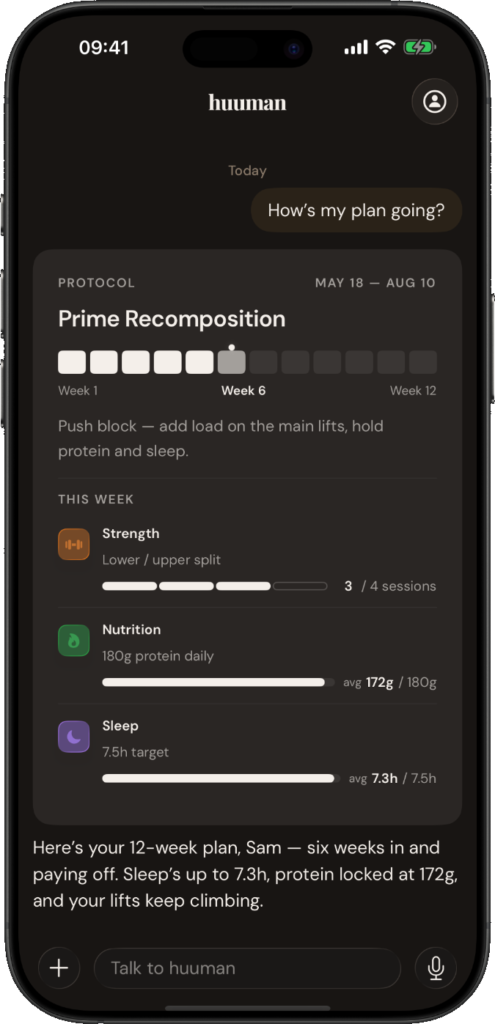
Looking for personal fitness coach near you? Try huuman, the personalized coaching app that helps people stay healthy, strong, and capable, and we are building a small network of blogs to work with over the long term.